
Heat Pump Water Heater vs Tankless: Cost, Space, Climate
Heat pump water heater or tankless? Operating cost from UEF and 2025 EIA prices, plus space, climate, flow rate and power needs for each, side by side.
A heat pump water heater (also sold as a hybrid water heater) and a tankless water heater are the two efficient replacements for an old tank, and they solve opposite problems. One spends floor space to save energy; the other spends gas or amps to save space and never run out. This page compares them on the numbers that decide it: running cost, space, climate, flow and power.
What is the difference between a heat pump water heater and a tankless?
A heat pump water heater is a storage tank with a small heat pump on top: a compressor and fan pull heat out of the surrounding air and move it into the water, with electric elements as backup. A tankless water heater has no tank; a gas burner or electric elements heat water only while a tap is open, as it flows through.
| Factor | Heat pump water heater | Gas tankless | Electric tankless |
|---|---|---|---|
| Example model (ENERGY STAR listing) | Rheem ProTerra XE50T10H45U1, 50 gal | Navien NPE-240A2 | Not covered by ENERGY STAR |
| UEF (efficiency) | 3.88 | 0.95 | about 0.98 (resistance heat) |
| Size | 61.8 in tall, 22.3 in diameter | 27 x 17 x 13 in, on a wall | Small, on a wall |
| Hot water supply | 67 gal first hour, then slower | 5.6 GPM at a 67°F rise, unlimited duration | Depends on kW; whole-house units need very large service |
| Power or fuel | 240 V, 21 A max (120 V models exist) | Gas line sized for 199,000 BTU/h, plus a 120 V outlet | 240 V, often several large circuits |
| Room needs | Large, warm space; makes the room cooler | Venting to outside | None special |
| Running cost, typical household | about $147 a year | about $175 a year | about $580 a year |
Running costs are worked out in the next section. UEF is the federal Uniform Energy Factor: units of hot-water energy delivered per unit of energy bought, so higher is better. A heat pump can exceed 1.0 because it moves heat from the air rather than making it.
Which costs less to run?
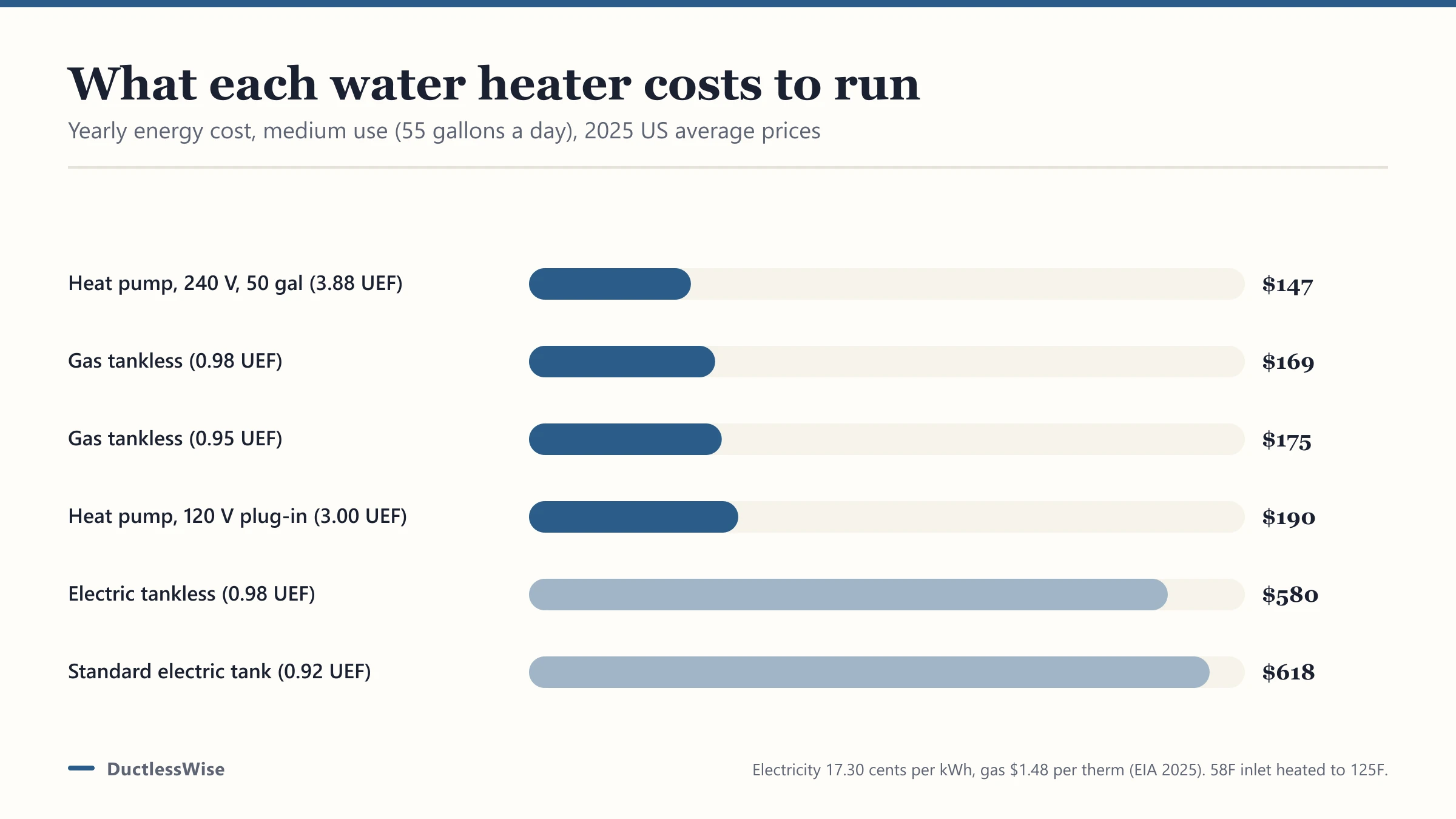
At 2025 US average prices, the heat pump water heater costs the least to run, a gas tankless comes second, and electric tankless costs about four times as much as either. The math below uses the federal UEF test conditions, so every option heats the same water: inlet water at 58°F heated to 125°F, a 67°F rise (10 CFR 430, Appendix E). The medium-usage pattern draws 55 gallons a day, 11.2 million BTU a year; high usage draws 84 gallons, 17.1 million BTU.
Prices are the 2025 US residential averages from the EIA: electricity 17.30 cents per kWh and natural gas $15.34 per thousand cubic feet, which is $1.48 per therm at the EIA’s 2025 heat content of 1,036 BTU per cubic foot.
| Water heater (UEF) | Medium use, 55 gal/day | Cost | High use, 84 gal/day | Cost |
|---|---|---|---|---|
| Heat pump, 240 V, 50 gal (3.88) | 847 kWh | $147 | n/a | n/a |
| Heat pump, 240 V, 80 gal (4.07) | n/a | n/a | 1,234 kWh | $213 |
| Heat pump, 120 V plug-in, 50 gal (3.00) | 1,096 kWh | $190 | n/a | n/a |
| Gas tankless (0.95) | 118 therms | $175 | 180 therms | $267 |
| Gas tankless (0.98) | 114 therms | $169 | 175 therms | $259 |
| Electric tankless (0.98) | 3,355 kWh | $580 | 5,123 kWh | $886 |
| Standard electric tank (0.92) | 3,573 kWh | $618 | n/a | n/a |
The formula is simple enough to run with your own bills: yearly BTU divided by UEF gives energy bought; divide by 3,412 for kWh or by 100,000 for therms, then multiply by your rate. Our 847 kWh for the ProTerra 50 matches its ENERGY STAR estimate of 846 kWh. For the efficiency figures behind each model, see the ENERGY STAR heat pump water heater list and water heater list, checked October 6, 2026.
When does gas tankless beat a heat pump water heater on running cost?
When gas is cheap relative to electricity. Dividing the two medium-use results gives a break-even rule: the heat pump water heater costs less to run whenever your gas price per therm is more than about 7.2 times your electricity price per kWh (7.4 against a 0.98 UEF tankless). At 17.30 cents per kWh, the break-even gas price is about $1.24 per therm; the 2025 average was $1.48.
So a home paying 30 cents per kWh needs gas above about $2.15 per therm for the heat pump to win, and a home paying 12 cents needs only about $0.86. Check both rates on your bills, including delivery charges, before deciding. For propane, use about 91,500 BTU per gallon in the same formula; propane often costs more per BTU than natural gas, which favors the heat pump.
One effect the table leaves out: a heat pump water heater inside the house pulls heat from the room. In summer that is free cooling and dehumidifying; in a heated basement in winter, your heating system replaces some of that heat.
How much space does each one need?
A heat pump water heater needs floor space, height and air; a tankless needs only a wall. The Rheem ProTerra 50-gallon is 61.8 inches tall and 22.3 inches across, and the 80-gallon is 74.2 inches tall, per their ENERGY STAR listings. A Navien NPE-240A2 measures 27 x 17 x 13 inches and hangs on the wall.
Air matters more than footprint for the heat pump. ENERGY STAR advises 1,000 cubic feet of air space around the unit, about a 12 x 12 ft room with a 7 ft ceiling, and a space that stays between 40°F and 90°F year-round. Rheem says its ProTerra Hybrid and Plug-in with HydroBoost models need zero clearance and suit closets; most manuals allow a smaller room only with a louvered door or ducting, so read the manual for your exact model. Rheem rates the hybrid at 45 dBA, which matters if the unit sits next to a bedroom.
Which works better in a cold or hot climate?
A heat pump water heater works best where its room stays warm; a tankless works everywhere indoors but delivers less flow where groundwater is cold.
The heat pump’s compressor stops below a cutoff temperature, listed on ENERGY STAR as 37°F for Rheem ProTerra and A. O. Smith’s newer models, 35 to 37°F for Bradford White, 35°F for GE Profile, and 23°F for LG’s units. Below that, a 240 V hybrid heats with its resistance elements at roughly standard-electric-tank cost. A basement in Minnesota is fine; an unheated garage in Minnesota is a poor home for one. In the South, a hot garage is close to ideal.
Tankless flow falls as the temperature rise grows. Flow equals burner output divided by 500 times the rise, so the NPE-240A2’s 5.6 GPM at a 67°F rise becomes about 4.9 GPM at a 77°F rise (43°F winter groundwater to 120°F) and about 8.3 GPM at a 45°F rise in a warm climate.
Which supplies more hot water?
A tankless never runs out but limits how many taps run at once; a heat pump water heater runs as many taps as you like until the stored water is gone, then recovers slowly. The ProTerra 50’s first-hour rating is 67 gallons, and the 80-gallon model’s is 87 gallons.
With federal showerheads capped at 2.5 GPM, a 4.9 GPM winter tankless covers two showers at full flow, not two showers and a running dishwasher. A 50-gallon heat pump tank covers two back-to-back showers easily but can run short when three people shower in a row and someone starts a bath. Households with a soaking tub or teenagers usually step up to the 65- or 80-gallon heat pump size. For the classic tank-versus-tankless trade-off, see tankless vs tank water heater.
What power or gas does each need?
This is where many conversions get expensive, and it is work for a licensed plumber, gas fitter or electrician under local code.
- Heat pump water heater, 240 V: the ProTerra 50 lists 21 A maximum and 4.5 kW backup elements, so it needs a 240 V circuit, usually the one an old electric tank already has. Replacing a gas tank means adding one, plus a condensate drain.
- Heat pump water heater, 120 V: Rheem’s ProTerra Plug-in models run on a 120 V, 15 A dedicated circuit, or a shared circuit for the HydroBoost version, which avoids new 240 V wiring.
- Gas tankless: whole-house units burn up to 199,000 BTU/h. ENERGY STAR-certified gas tanks are rated 50,000 to 65,000 BTU/h, so the gas line often needs upsizing, plus new venting and a 120 V outlet.
- Electric tankless: heating 4 GPM by 70°F takes about 41 kW, roughly 171 A at 240 V, which many homes’ electrical service cannot spare.
What do they cost to buy and install?
Installed prices overlap heavily, so the conversion work decides which is cheaper for your house. The ranges below are from HomeGuide’s 2026 cost guides, read on October 6, 2026; retail examples are listings checked the same day.
| Option | Unit only | Installed | Retail example (Amazon, October 2026) |
|---|---|---|---|
| Hybrid heat pump water heater | $1,500 to $3,000 | $2,000 to $4,600 | Rinnai REHP50, $1,799.00 |
| Gas tankless (natural gas or propane) | $1,000 to $2,600 | $1,600 to $5,600 | Rinnai RX199iN, $1,532.79 |
| Electric tankless | $600 to $1,000 | $1,400 to $3,000 | n/a |
The extras HomeGuide lists are where quotes split: a larger gas line $350 to $2,000, new venting $100 to $600 (an old tank’s vent cannot be reused for a tankless), a dedicated electrical circuit $250 to $900, and a panel replacement $850 to $1,700 when the service is too small. At average 2025 energy prices the heat pump saves only about $28 a year over a gas tankless, so if one option needs a new gas line or a new panel and the other does not, that one-time cost usually outweighs the running-cost gap. Our tankless water heater cost guide breaks the tankless side down by fuel.
Which one should you choose?
Choose the heat pump water heater if you have a basement, utility room or warm garage with space and air, electricity is not much more than one-seventh of your gas price per therm, and you want the lowest running cost. Choose a gas tankless if space is tight, you already have a gas line big enough or can upsize it, and you want unlimited back-to-back showers. Electric tankless suits point-of-use jobs and small homes with very large electrical service, not most whole-house replacements.
The federal 25C credit, which covered up to $2,000 a year for heat pump water heaters, does not apply to equipment placed in service after December 31, 2025, per the IRS. Some states run heat pump water heater rebates under the federal HEAR program, and some utilities offer their own; check your state energy office and utility before you buy.
Who should skip each option?
Skip a heat pump water heater if the only spot is a small sealed closet with no venting option, an unheated space that sits below about 40°F for months, or next to a bedroom where 45 dBA would bother you. Skip a gas tankless if your gas meter and line cannot supply 199,000 BTU/h without major work, your water is hard and you will not descale it (see how to flush a tankless water heater), or you want hot water during power outages.
For model picks, read the best heat pump water heaters or the best gas tankless water heaters. For installed prices, gas line and venting costs, see the tankless water heater cost guide.
Frequently asked questions
Quick answers to what readers ask us most
Is a heat pump water heater cheaper to run than a gas tankless?
At 2025 US average prices, yes: about $147 a year against $175 for a typical household. It flips where gas is cheap. The heat pump wins whenever your gas price per therm is more than about 7.2 times your electricity price per kWh.
Can a heat pump water heater go in a closet?
Some can. ENERGY STAR advises about 1,000 cubic feet of air space, while Rheem says its ProTerra Hybrid and Plug-in with HydroBoost models need zero clearance and suit closets. Check your model's manual for the venting or louvered-door option it requires.
Does a heat pump water heater work in a cold garage?
Only partly. The compressor shuts off below its cutoff, 37°F on Rheem ProTerra models, and the tank then heats with resistance elements at much higher cost. ENERGY STAR recommends a space that stays between 40°F and 90°F year-round.
How many showers can a tankless water heater run at once?
A 199,000 BTU gas unit rated 5.6 GPM at a 67°F rise drops to about 4.9 GPM with 43°F winter groundwater heated to 120°F. That covers two full showers, not three, in a northern winter.
Do either of these work in a power outage?
Neither does. A heat pump water heater runs on electricity, and gas tankless units need a 120 V outlet for their controls and fan. A gas tank with a standing pilot is the only common type that keeps heating with the power out.