
Tankless Water Heater Cost: Gas, Propane, and Electric
Tankless water heater cost in 2026 by fuel: unit prices, installed ranges, the gas line, venting and electrical extras, yearly running cost and honest payback.
A tankless water heater heats water as it flows through, so there is no tank to keep hot and no point where the hot water runs out. It also costs two to three times what a tank does to install, and the gap is mostly in the extras: gas lines, venting and electrical service. This page prices each part with dated sources and runs the payback math honestly.
How much does a tankless water heater cost in 2026?
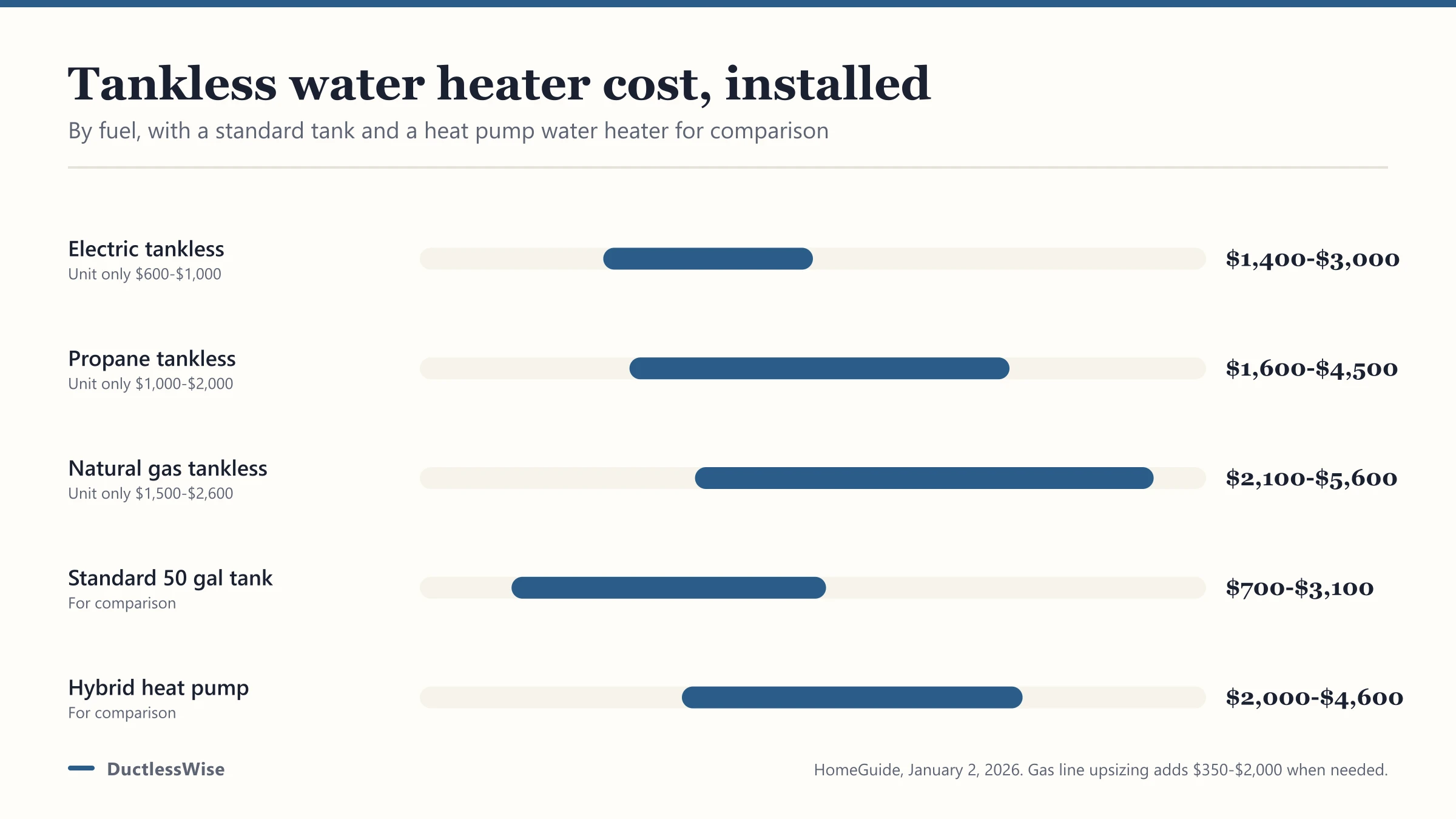
A tankless water heater costs $1,400 to $5,600 installed, according to HomeGuide’s cost guide updated January 2, 2026. Fuel type sets most of the range.
| Fuel | Unit only | Installed |
|---|---|---|
| Electric | $600-$1,000 | $1,400-$3,000 |
| Propane | $1,000-$2,000 | $1,600-$4,500 |
| Natural gas | $1,500-$2,600 | $2,100-$5,600 |
For comparison, the same HomeGuide guide prices a standard 50-gallon tank at $700 to $3,100 installed and a hybrid heat pump water heater at $2,000 to $4,600. Single-point electric units for one sink cost $150 to $250 each and are a different product from the whole-house units priced here.
What do real tankless units cost right now?
Street prices on October 6, 2026 show where common models sit inside those bands. Marketplace prices move often, so treat these as a snapshot.
| Model | Type | Rated flow (ENERGY STAR, 67 F rise) | Price, Oct 2026 |
|---|---|---|---|
| Rheem RTEX-27 | Electric, 27 kW | Not listed | $641.59 (Walmart marketplace) |
| EcoSmart ECO 36 | Electric, 36 kW | Not listed | $899.99 (Amazon) |
| Rinnai RUCS65iP | Propane, indoor | Not listed | $849.00 (Amazon) |
| Rheem RTG-95DVLN-3 | Natural gas, non-condensing | Not listed | $1,079.99 (Amazon) |
| Rinnai RX160iN | Natural gas, condensing, 160,000 BTU/h | 4.6 GPM, 0.97 UEF | $1,298.43 (Amazon) |
| Rinnai RX199iN | Natural gas, condensing, 199,000 BTU/h | 5.8 GPM, 0.98 UEF | $1,532.79 (Amazon) |
| Rheem Ikonic RECTGH-SR11iP | Propane, condensing, 199,000 BTU/h | 5.8 GPM, 0.96 UEF | $2,204.08 (Walmart marketplace) |
Rated flow matters more than the headline number on the box. Rheem markets the RTG-95 as a 9.5 GPM unit, but that figure assumes a small temperature rise; ENERGY STAR lists 199,000 BTU/h condensing units at 5.6 to 5.8 GPM at a 67 F rise, which is closer to a northern winter. Our best gas tankless water heaters compare rated flow and UEF model by model.
What does installation add to the price?
Installation adds $800 to $3,000 on a straightforward job, and more when the house needs upgrades. HomeGuide’s January 2026 line items:
| Line item | Typical cost |
|---|---|
| Installation labor (plumber, gas fitter or electrician) | $600-$2,500 |
| Pipes, connectors and valves | $150-$300 |
| Permits | $50-$200 |
| Gas line upsizing to a larger diameter | $350-$2,000 |
| Replacing exhaust vents | $100-$600 |
| New dedicated electrical circuit | $250-$900 |
| Electrical panel replacement | $850-$1,700 |
| Old tank removal and disposal | $75-$500 (often included) |
HomeGuide notes that an old tank’s vent cannot be reused for a tankless unit, and that condensing models need their own venting material and a condensate drain. Gas work, venting and wiring are jobs for a licensed plumber, gas fitter and electrician under local code; the manufacturer’s manual sets the clearances and vent lengths.
Why does electric tankless cost so much to wire?
Heating water on demand takes a lot of power at once. A 27 kW unit draws about 112 amps at 240 V (27,000 W divided by 240 V), and a 36 kW unit about 150 amps. Many homes with 100 or 150 amp service cannot spare that, which is where a panel or service upgrade enters the quote.
The same physics limits flow. Water heating output in BTU/h equals about 500 x GPM x temperature rise. A 27 kW unit (about 92,000 BTU/h) delivers about 4.1 GPM at a 45 F rise but only about 2.6 GPM at a 70 F rise, which is a typical winter rise where groundwater is cold.
| Heater | Output | GPM at 45 F rise | GPM at 70 F rise |
|---|---|---|---|
| Electric 27 kW | about 92,000 BTU/h | 4.1 | 2.6 |
| Electric 36 kW | about 123,000 BTU/h | 5.5 | 3.5 |
| Gas 199,000 BTU/h at 0.95 | about 189,000 BTU/h | 8.4 | 5.4 |
That is why whole-house electric tankless suits warm-groundwater regions and small households better than northern homes with two showers running.
What does a tankless water heater cost to run?
Gas tankless is cheap to run; electric tankless is not. ENERGY STAR rates a 0.95 UEF gas tankless unit at 178 therms a year (or about 195 gallons of propane) on its high-usage test load. At the 2025 US average residential gas price of $15.34 per thousand cubic feet (about $1.48 per therm, EIA), that is about $263 a year.
| Water heater (high-usage test load) | Yearly energy | Cost/yr |
|---|---|---|
| Gas tankless, 0.95 UEF | 178 therms | about $263 |
| Gas tank, 50 gal, federal minimum 0.63 UEF | about 270 therms | about $399 |
| Electric tank, 50 gal, federal minimum 0.93 UEF | about 5,330 kWh | about $975 |
| Electric tankless, 0.92 (federal minimum) to 1.0 | about 4,960-5,390 kWh | about $910-$985 |
Gas tank and electric figures are our estimates from the federal minimum efficiencies in 10 CFR 430.32 and the same delivered hot water; electricity is priced at the EIA’s July 2026 US average of 18.31 cents per kWh. Electric tankless saves little or nothing over an electric tank, because both turn nearly all their electricity into heat. A heat pump water heater uses roughly a quarter of that electricity.
How long is the payback on a tankless water heater?
Usually longer than the sales pitch suggests. Against a standard gas tank, a 0.95 UEF gas tankless unit saves about $135 a year at 2025 average gas prices. At the middle of HomeGuide’s ranges it costs about $1,950 more installed ($3,850 vs $1,900), so simple payback is roughly 14 years.
HomeGuide gives tankless units a 15 to 20 year life against 8 to 12 years for a tank, so a buyer who replaces a tank once during that period narrows the gap. Payback is shorter for big households, propane users facing high prices and anyone replacing a tank in a tight space anyway.
The stronger reasons to buy are continuous hot water and a wall-mounted unit in place of a tank. Our tankless vs tank comparison weighs those against the cold-water sandwich and flow limits, and the heat pump vs tankless comparison covers the all-electric choice.
Condensing or non-condensing: is the extra cost worth it?
For most whole-house gas installs, yes. Condensing units capture heat from the exhaust and reach 0.95 to 0.98 UEF in the ENERGY STAR list. They cost more and need PVC-type venting plus a condensate drain, while non-condensing units cost about 25% less to install according to HomeGuide.
Within Rheem’s line on October 6, 2026, the non-condensing RTG-95DVLN-3 listed at $1,079.99 and the condensing RTGH-95DVLN-3 at $1,459.12 (Walmart marketplace), a gap of about $380. The vent run and the drain location in your house usually decide the installed difference.
What size tankless water heater do you need?
Size by how many fixtures run at once and how cold your incoming water gets. HomeGuide’s rule of thumb: about 3.5 GPM for one or two fixtures, 5 GPM for two or three, and 7 GPM or more for three or four.
Check the rated flow at your winter temperature rise, not the box’s headline figure. A 199,000 BTU/h gas unit handles two showers at a 70 F rise; a 27 kW electric unit handles about one. Our tankless sizing guide works through the GPM math fixture by fixture.
Who should not buy a tankless water heater?
A tankless unit is a poor buy in these cases:
- Your gas tank is under 10 years old and works. The payback is too long to justify early replacement.
- You want all-electric and live where groundwater is cold. Whole-house electric tankless struggles on flow and may need a service upgrade; compare a heat pump water heater.
- Your water is hard and you will not flush the unit. Scale cuts flow and efficiency; see our tankless flush guide for what yearly upkeep involves.
- The quote needs a new gas line, new venting and a panel upgrade together. At that point the total can pass $6,000.
Where do these numbers come from?
- HomeGuide, tankless water heater cost, updated January 2, 2026: ranges by fuel, line items, sizing rule, lifespan.
- HomeGuide, water heater installation cost, January 2, 2026: tank and hybrid comparison prices.
- ENERGY STAR Certified Residential Water Heaters dataset (data.energystar.gov, read October 6, 2026): UEF, rated flow, therms and propane gallons per year.
- EIA natural gas prices, 2025 US residential average; EIA Electric Power Monthly Table 5.6.A, July 2026.
- 10 CFR 430.32(d): federal minimum water heater efficiency.
- Street prices: Amazon and Walmart marketplace listings, October 6, 2026.
- IRS, Energy Efficient Home Improvement Credit, read October 6, 2026.
Frequently asked questions
Quick answers to what readers ask us most
How much does it cost to install a tankless water heater?
HomeGuide's January 2026 data puts the total at $1,400 to $5,600: the unit is $600 to $2,600, labor $600 to $2,500, supplies $150 to $300 and permits $50 to $200. Converting from a tank costs more than replacing a tankless unit, because gas lines, venting or electrical service often need upgrades.
Is a gas or electric tankless water heater cheaper?
Electric is cheaper to buy and install ($1,400 to $3,000 vs $2,100 to $5,600 for natural gas), but it usually costs more to run. At 2025 to 2026 US average prices, a 0.95 UEF gas unit uses about $263 of gas a year on the ENERGY STAR test load, while an electric tankless unit uses about $910 to $985 of electricity at the July 2026 average power price.
How long does a tankless water heater take to pay for itself?
Against a standard gas tank, often 10 to 15 years or more. A 0.95 UEF gas tankless unit saves about $135 a year at the 2025 US average gas price, while it costs roughly $1,950 more installed at the middle of HomeGuide's ranges. The better reasons to buy one are continuous hot water, wall mounting and a 15 to 20 year life.
Why do whole-house electric tankless water heaters need so much power?
Because heating water on demand takes a lot of power at once. A 27 kW unit draws about 112 amps at 240 V and a 36 kW unit about 150 amps, which can exceed what a 100 or 150 amp service can spare. A licensed electrician has to confirm the panel and service before you buy.
Can I still get a tax credit for a tankless water heater?
Not for one installed in 2026. Older cost guides still mention a federal credit, but the IRS lists the 25C credit as covering property placed in service through December 31, 2025. Check the ENERGY STAR Rebate Finder for state or utility rebates.