
Best Heat Pump Water Heaters: Models, UEF, and Real Costs
The best heat pump water heaters of 2026 compared on UEF, first-hour rating, voltage and cold-space limits, with yearly running costs and who should skip one.
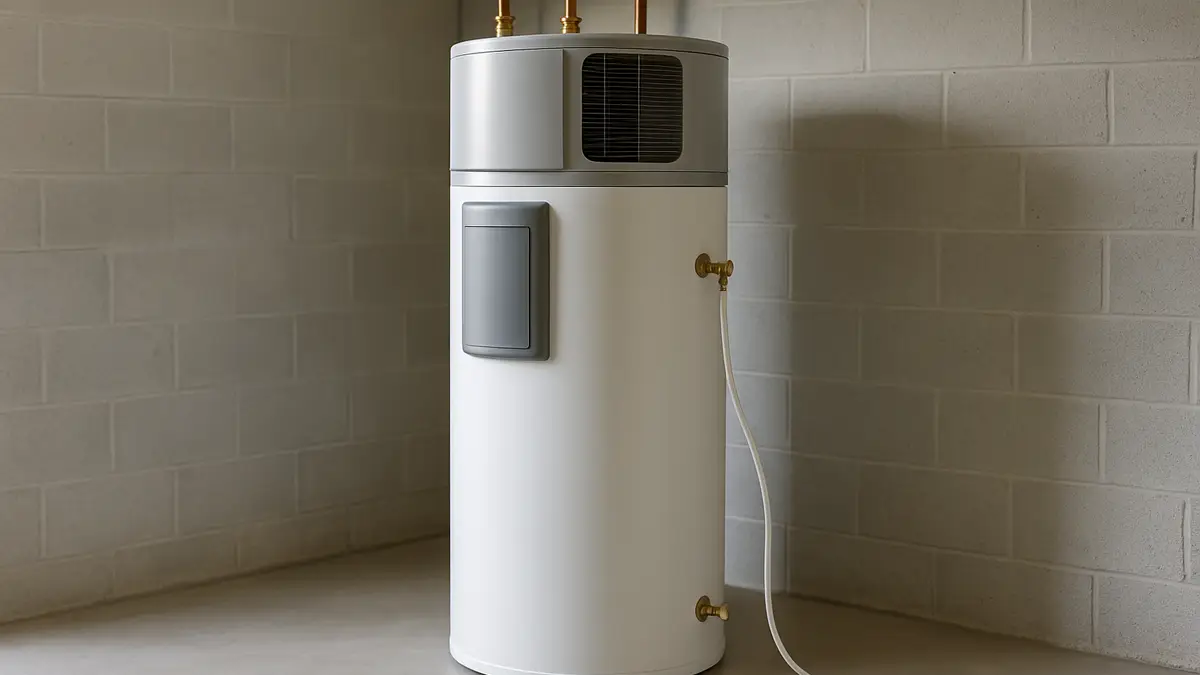
A heat pump water heater (also sold as a hybrid water heater) is a tank water heater with a small heat pump on top that pulls heat from the surrounding air. It uses a fraction of the electricity of a standard electric tank, as long as the space around it is big enough and warm enough. This page compares the models on the ENERGY STAR certified list as of October 6, 2026, and shows what they cost to run.
Which heat pump water heaters are best in 2026?
The best choice for most homes is a 50-gallon, 240 V hybrid rated around 3.8 to 3.9 UEF from a brand with plumber support in your area. The table compares common models by their ENERGY STAR listing.
| Model | Volts | Storage (gal) | First-hour rating (gal) | UEF | Max amps | Compressor low cut-off |
|---|---|---|---|---|---|---|
| Rheem ProTerra PROPH50 T2 RH400-30 | 240 | 45 | 67 | 3.88 | 21 | 37 F |
| Bradford White AeroTherm RE2HP50 | 240 | 45 | 65 | 3.89 | 19 | 37 F |
| A. O. Smith HPTS-50 | 240 | 46 | 65 | 3.80 | 22 | 37 F |
| GE Profile PK50S10FNY01 | 240 | 50 | 60 | 4.20 | 23 | 35 F |
| Rinnai REHP50 | 240 | 46 | 73 | 3.75 | 24 | 37.4 F |
| Navien NWP500S050AUMB | 240 | 44 | 65 | 3.85 | 23 | 41 F |
| LG APHWC502M | 240 | 53 | 81 | 4.20* | 24 | 23 F |
| Rheem ProTerra Plug-in PROPH50 T0 RH120-M | 120 | 46 | 55 | 3.00 | 4.5 | n/a |
| GE Profile PF50S10FPY01 | 120 | 50 | 59 | 3.20 | 7.5 | 35 F |
*Tested on the high-usage draw pattern; all others on the medium pattern. Source: ENERGY STAR Certified Residential Water Heaters dataset, read October 6, 2026. Rheem also sells the PROPH50 platform as the Performance Platinum XE50T10H45U1 with identical ratings.
Best overall: Rheem ProTerra or Bradford White AeroTherm?
Both are top picks for a standard 50-gallon replacement, and they are close enough that local availability should decide. The Rheem ProTerra PROPH50 T2 RH400-30 is rated 3.88 UEF with a 67-gallon first-hour rating; ENERGY STAR lists it at 846 kWh a year. The Bradford White AeroTherm RE2HP50 is rated 3.89 UEF with a 65-gallon first-hour rating and the lowest current draw of the 240 V group at 19 A.
Rheem’s advantage is reach: it also ships under the Performance Platinum name through big-box retail. Bradford White sells mainly through professional plumbing channels, which suits a plumber-installed job. If lowest running cost matters more than recovery, the GE Profile PK50S10FNY01 is the efficiency leader at 4.20 UEF and 773 kWh a year, with a smaller 60-gallon first-hour rating. Either way, plan for a condensate drain and the space rules below.
Not for: closets under 1,000 cubic feet without the louvered door or ducting the manual allows, or garages that drop below freezing.
Best for a cold garage or basement: which model keeps working?
The LG APHWC502M is the strongest standard tank choice for cool spaces. Its ENERGY STAR listing shows the compressor running down to 23 F, against 35 to 41 F for the other tanks in the table. Below a model’s cut-off it heats with resistance elements, which costs about as much as a standard tank.
LG also lists 81 first-hour gallons and 4.20 UEF on the high-usage pattern, from a 53-gallon tank. For homes where the tank sits in an unheated space through a northern winter, a split CO2 system is the other answer. SANCO2 puts the heat pump outdoors and lists compressor operation down to -26 F, with an 83-gallon tank rated 121 first-hour gallons. It is a two-piece system, so expect a more involved installation than a single tank.
Not for: small households with a warm utility room, where a low compressor cut-off brings no benefit.
Best 120 V plug-in: when is it the right call?
A 120 V plug-in model is the right call when you are replacing a gas tank and there is no 240 V circuit near the water heater. The Rheem ProTerra Plug-in PROPH50 T0 RH120-M lists 4.5 maximum amps; the GE Profile PF50S10FPY01 lists 7.5 A; A. O. Smith’s HPTV-50 lists 15 A.
The trade-off is recovery. Without a 4,500 W element to fall back on, 120 V models in the 50-gallon class rate 51 to 59 first-hour gallons, against 60 to 81 for the 240 V tanks above. Rheem and A. O. Smith offer 65- and 80-gallon 120 V tanks to make up the difference; the Rheem 80-gallon plug-in lists 84 first-hour gallons.
Not for: large households that run several showers back to back, unless they step up to a 65- or 80-gallon tank.
How much does a heat pump water heater cost to run?
At the EIA’s July 2026 US average residential price of 18.31 cents per kWh, a 50-gallon heat pump water heater costs about $150 to $200 a year to run on the ENERGY STAR test pattern. A standard 50-gallon electric tank at the federal minimum (0.92 UEF) uses about 3,560 kWh on the same pattern, or about $650.
| Water heater | Rated kWh/yr | Cost/yr at 18.31 c/kWh |
|---|---|---|
| GE Profile PK50 (4.20 UEF) | 773 | $142 |
| A. O. Smith HPTS-50 (3.80 UEF) | 831 | $152 |
| Bradford White RE2HP50 (3.89 UEF) | 835 | $153 |
| Rheem ProTerra PROPH50 (3.88 UEF) | 846 | $155 |
| GE Profile PF50 120 V (3.20 UEF) | 1,015 | $186 |
| Rheem ProTerra Plug-in 50 120 V (3.00 UEF) | 1,072 | $196 |
| Standard electric tank, 50 gal (0.92 UEF) | about 3,560 (our estimate) | about $652 |
The tank figure is our estimate from the federal minimum efficiency and the same medium-usage test load. Real savings shrink when the tank sits in a cold space and grow in high-price states: at July 2026 rates, a 3.88 UEF model saves about $400 a year in Washington (14.71 cents) and about $915 in California (33.61 cents).
What does a heat pump water heater cost to buy and install?
HomeGuide’s January 2026 data puts a hybrid heat pump water heater at $1,500 to $3,000 for the unit and $2,000 to $4,600 installed, against $700 to $3,100 installed for a standard 50-gallon tank. Rinnai’s REHP50 listed at $1,799 on Amazon on October 6, 2026.
Using midpoints, the heat pump model costs about $1,400 more installed. At roughly $500 a year in savings at the US average power price, that premium pays back in about three years in a warm space. Gas-to-heat-pump swaps cost more when a new 240 V circuit is needed; HomeGuide prices a gas-to-electric conversion at $250 to $1,000 or more for the circuit and wiring.
If you are still choosing between technologies, compare a heat pump water heater with tankless on running cost and space, or see what a tankless water heater costs installed.
What space and installation does a heat pump water heater need?
ENERGY STAR advises installing a heat pump water heater in an interior space that stays between 40 and 90 F year-round, with about 1,000 cubic feet of air around it (a 12 x 12 ft room with a 7 ft ceiling). Some manuals allow smaller rooms with a louvered door or duct kit; follow the one for your model.
The heat pump moves heat out of the room, so the space gets cooler and drier while it runs. It also produces condensate that needs a drain or a condensate pump, and it adds fan and compressor noise, so a closet next to a bedroom is a poor spot. Most units are taller than the tank they replace: the Rheem PROPH50 listing gives a 61.8 in height.
Installation is a plumber’s job for the water, relief valve and condensate connections, and an electrician’s job for any new circuit. If a check valve or pressure-reducing valve closes the house’s water system, plan for a thermal expansion tank as well. Follow the manual and local code, and pull the permit your town requires.
Is there a tax credit or rebate for heat pump water heaters?
There is no federal tax credit for a heat pump water heater installed in 2026. The IRS lists the 25C credit, which allowed up to $2,000 a year for qualifying heat pump water heaters, as covering property placed in service through December 31, 2025.
State-run rebate programs and utility rebates still exist in some areas and change often. Check the ENERGY STAR Rebate Finder and your utility before you buy, and confirm whether the rebate requires a specific model list or a participating installer. Status checked October 6, 2026.
Will standard electric tanks be phased out?
Largely, yes, starting in 2029. Under the federal standard in 10 CFR 430.32, electric storage water heaters from 20 to 55 gallons made on or after May 6, 2029 must reach 2.30 UEF, and 55 to 120 gallon models 2.50 UEF. Only heat pump designs reach those levels; small low-use tanks keep a lower standard.
Today’s minimum for a 50-gallon electric tank on the medium pattern is about 0.92 UEF. Buying a standard tank now is still legal, but a replacement in 2029 or later will most likely be a heat pump model either way.
Who should not buy a heat pump water heater?
A heat pump water heater is a poor fit in four situations:
- The only spot is a small closet with no allowed louvered door or duct option.
- The tank sits in a space that drops below about 40 F for months, unless you choose a low cut-off model or a split CO2 system.
- Gas is cheap and the gas tank is young. Compare fuel costs first in our tankless vs tank comparison.
- You need endless hot water for long back-to-back use and cannot fit a larger tank; a tankless unit may suit better.
Where do these numbers come from?
- ENERGY STAR Certified Residential Water Heaters dataset (data.energystar.gov, read October 6, 2026): UEF, first-hour rating, storage, voltage, amps, kWh per year, compressor cut-off.
- ENERGY STAR heat pump water heater guidance: 40 to 90 F and 1,000 cubic feet.
- EIA Electric Power Monthly, Table 5.6.A, July 2026 residential prices, released September 24, 2026.
- HomeGuide, water heater installation cost, updated January 2, 2026.
- 10 CFR 430.32(d), federal water heater efficiency standards.
- IRS, Energy Efficient Home Improvement Credit, read October 6, 2026.
- Price: Amazon listing for Rinnai REHP50, October 6, 2026.
Frequently asked questions
Quick answers to what readers ask us most
What is the most efficient heat pump water heater?
Among 50-gallon models tested on the medium-usage pattern, the GE Profile PK50S10FNY01 leads the ENERGY STAR list at 4.20 UEF (773 kWh a year), followed by the Bradford White RE2HP50 (3.89) and Rheem ProTerra PROPH50 (3.88). GE PH50 and LG APHWC502 models list 4.20 to 4.50 on the high-usage pattern. Compare UEF only between models tested on the same pattern.
How much does a heat pump water heater save?
At the EIA's July 2026 US average of 18.31 cents per kWh, a 3.88 UEF 50-gallon model rated at 846 kWh a year costs about $155 to run, against roughly $650 for a standard electric tank: about $500 a year. Savings are smaller in cold basements and in low-price states, and larger where power is expensive.
Do heat pump water heaters work in cold basements?
Down to a point. ENERGY STAR advises a space that stays between 40 and 90 F. Most models stop the compressor around 35 to 41 F and switch to electric resistance, which costs about as much as a standard tank. The LG models in the ENERGY STAR list run the compressor down to 23 F, and split CO2 systems such as SANCO2 put the heat pump outdoors.
Is there a tax credit for heat pump water heaters in 2026?
No federal credit for units installed in 2026. The IRS lists the 25C credit (up to $2,000 a year for heat pump water heaters) as available for property placed in service through December 31, 2025. Some states and utilities still offer rebates; check the ENERGY STAR Rebate Finder.
Can a 120 V plug-in heat pump water heater replace a gas water heater?
Often, yes. 120 V models such as the Rheem ProTerra Plug-in draw 4.5 to 15 amps per their ENERGY STAR listings, so many homes avoid a new 240 V circuit. The trade-off is slower recovery: first-hour ratings of 51 to 59 gallons in the 50-gallon class versus 60 to 81 for 240 V models.