
Tankless vs Tank Water Heater: Which Is Worth It
Tankless vs tank water heater compared on real flow rates, the cold-water sandwich, lifespan, upkeep, gas vs electric running cost and 15-year cost.
A tank water heater keeps 40 to 80 gallons hot around the clock. A tankless (instant) water heater fires a burner or electric elements only when a tap opens. That one difference drives everything below: what each costs, how much hot water each delivers, how long each lasts and what each needs from you. This page compares them with published specs and dated prices.
Which is better, a tankless or a tank water heater?
Neither wins for every home. A gas tankless heater suits a household that runs out of hot water, has natural gas or propane, and has a wall to mount it on. A tank suits a smaller budget, a home that runs three or more fixtures at once, or anyone who will not descale a heater on hard water.
| Your situation | Better choice | Why |
|---|---|---|
| Gas home, 3 or more people, tank runs out | Gas tankless | Never runs out; lowest gas use |
| Gas home, 1 to 2 people, tank under 10 years old | Keep the tank | Savings are too small to repay early replacement |
| All-electric home | Heat pump water heater | Electric tankless saves little over a tank |
| Tight space, no basement | Tankless | Wall-mounted; a Navien NPE-2 is 17.3 x 27.4 x 13.2 in |
| Hard water, no softener, no plans to flush | Tank | Scale is the main tankless failure path |
If you are all-electric, read our heat pump water heater vs tankless comparison before buying either.
How do tankless and tank water heaters compare side by side?
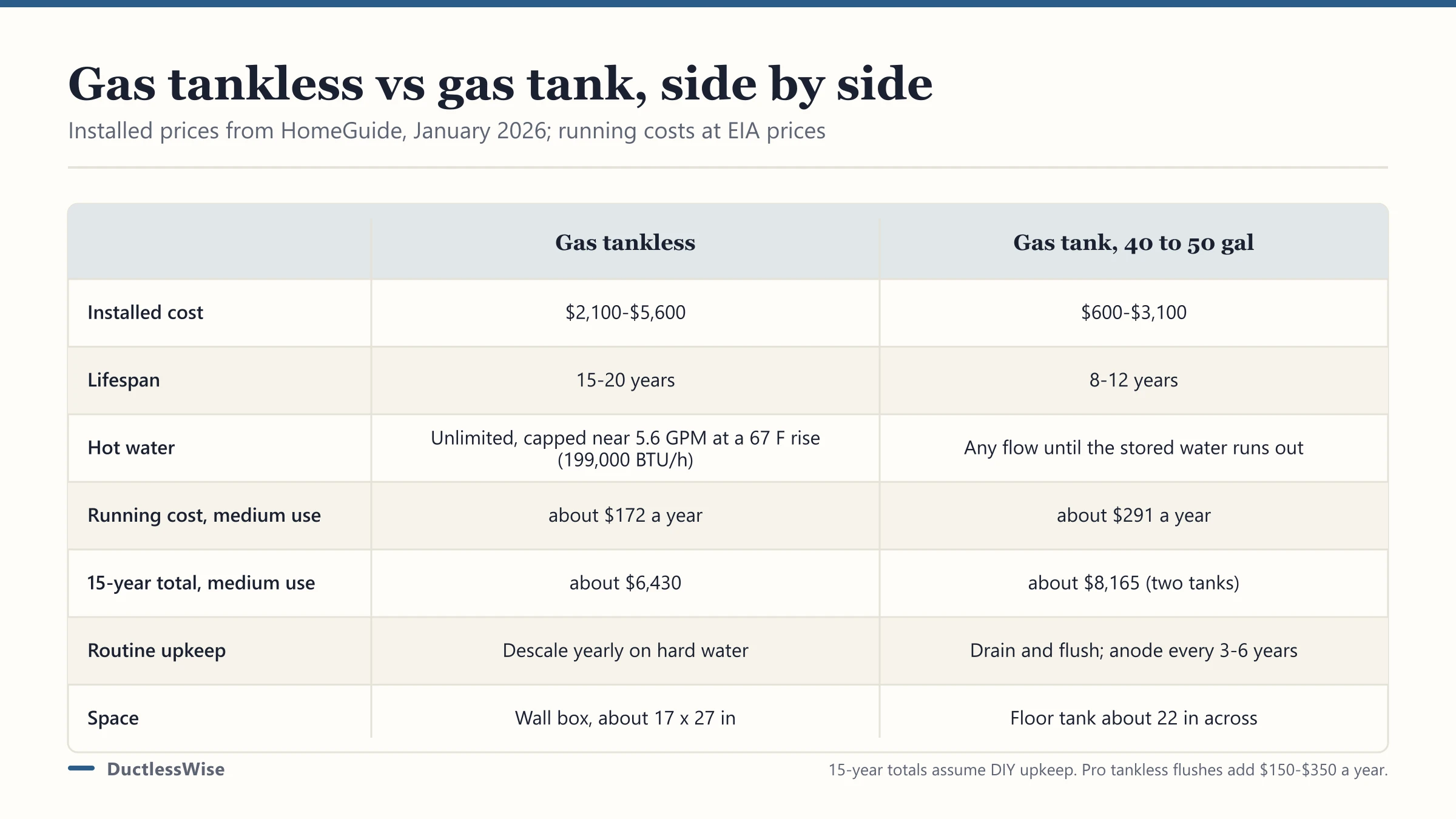
A tankless heater costs more to install and less to run on gas; a tank costs less up front and wears out sooner. The installed prices are HomeGuide’s January 2, 2026 national ranges.
| Factor | Tankless | Tank (40 to 50 gal) |
|---|---|---|
| Installed cost | $1,400-$3,000 electric, $2,100-$5,600 natural gas | $600-$3,100 |
| Lifespan (HomeGuide) | 15-20 years | 8-12 years |
| Hot water supply | Unlimited, but capped in gallons per minute | Unlimited flow until the stored water runs out |
| Gas input | Up to 199,000 BTU/h | Usually far less; ENERGY STAR gas tanks list 50,000-65,000 BTU/h |
| Space | Wall-mounted box, about 17 x 27 in | Floor space for a tank about 22 in across (ENERGY STAR gas tank listings) |
| Routine upkeep | Descale the heat exchanger (yearly on hard water) | Drain and flush; anode rod every 3-6 years |
| Typical install extras | Gas line upsizing, new venting, electrical service | Usually a like-for-like swap |
The gas input row is the hidden cost. A 199,000 BTU/h burner can need a larger gas line than the tank it replaces; our tankless water heater cost guide prices that and every other add-on line item.
How much hot water can a tankless heater actually deliver?
A tankless heater’s limit is flow, set by its burner or element power and how cold your incoming water is. Output in BTU/h equals about 500 x gallons per minute x temperature rise. Navien’s published table for the NPE-240A2 (199,000 BTU/h, 0.95 UEF) confirms the formula: 11.2 GPM at a 35 F rise, 8.7 GPM at 45 F and 5.6 GPM at 67 F.
A shower does not draw only hot water. With a 120 F heater setting, 50 F groundwater and a 105 F shower, about 79% of a 2.5 GPM shower is hot water, roughly 2.0 GPM. That gives these winter limits at a 67 to 70 F rise:
| Heater | Hot water at a 67 F rise | Showers at once (2.5 GPM heads) |
|---|---|---|
| Gas, 199,000 BTU/h condensing | about 5.6 GPM | 2, nearly 3 |
| Gas, 150,000 BTU/h | about 4.3 GPM | 2 |
| Electric, 36 kW | about 3.7 GPM | 1, nearly 2 |
| Electric, 27 kW | about 2.8 GPM | 1 |
The federal limit for new showerheads is 2.5 GPM at 80 psi (10 CFR 430.32(p)); a low-flow head stretches a tankless unit further. In warm-groundwater regions the rise is smaller and the same heater serves more fixtures. To size one for your own fixtures and inlet temperature, see what size tankless water heater you need.
What is the cold-water sandwich, and can you avoid it?
The cold-water sandwich is a short burst of cool water in the middle of a hot draw. It happens when someone shuts a tap and reopens it a minute later: the hot water left in the pipe arrives first, then the cold slug that sat in the heater while the burner relit, then hot water again.
Two features reduce it. A small internal buffer tank keeps a little hot water ready; Navien’s NPE-A2 models, for example, have a built-in pump and a 0.4 gallon buffer tank. Recirculation keeps the hot line warm, at some energy cost.
Tankless units also have a minimum flow before they fire, 0.5 GPM on the Navien NPE series. A faucet cracked open below that stays cold. Tanks have neither issue: stored hot water flows at any rate until the tank is drained, and recovery then takes time.
Gas or electric: which water heater fuel costs less to run?
Gas costs less at US average prices, and the gap is bigger than the gap between tank and tankless. The table uses the two DOE test loads (55 and 84 gallons of hot water a day at a 67 F rise), the 2025 US residential gas price of $15.34 per thousand cubic feet (about $1.48 per therm, EIA) and the July 2026 residential electricity price of 18.31 cents per kWh (EIA).
| Water heater | Medium use (55 gal/day) | High use (84 gal/day) |
|---|---|---|
| Gas tankless, 0.95 UEF (condensing) | about $172 | about $263 |
| Gas tank, 50 gal, federal minimum | about $291 | about $399 |
| Electric tankless, 0.91-1.0 UEF | about $594-$653 | about $907-$986 |
| Electric tank, 50 gal, federal minimum | about $645 | about $976 |
| Heat pump water heater, 3.88 UEF (ENERGY STAR) | about $155 | not rated |
Tank figures are our estimates from the federal minimums in 10 CFR 430.32(d); the heat pump row uses ENERGY STAR’s 846 kWh a year for the Rheem ProTerra PROPH50. Electric tankless saves almost nothing over an electric tank, because an electric tank’s only extra loss is standby heat through its walls. The best heat pump water heaters are the efficient all-electric option.
What does each option cost over 15 years?
Over 15 years a gas tankless heater comes out about $1,700 to $2,000 ahead of a gas tank, but only if you flush it yourself. That assumes HomeGuide’s midpoints ($3,850 installed for gas tankless, $1,900 for a 50-gallon tank), one tank replacement inside 15 years, and the running costs above.
| 15-year total (gas) | Tank | Tankless |
|---|---|---|
| Equipment and install | $3,800 (two tanks) | $3,850 (one unit) |
| Energy, medium use | $4,365 | $2,580 |
| Total, medium use, DIY upkeep | about $8,165 | about $6,430 |
| Energy, high use | $5,985 | $3,945 |
| Total, high use, DIY upkeep | about $9,785 | about $7,795 |
Paying a plumber every year changes the answer. HomeGuide’s May 2024 figures put a tankless flush at $150 to $350 and a tank flush at $75 to $150, which over 15 years adds $2,250 to $5,250 to tankless and $1,125 to $2,250 to the tank. With pro service on both, the two land roughly even. The tankless flush guide shows what the yearly job involves.
How long does each type last, and what upkeep does it need?
HomeGuide’s January 2026 guide gives tankless units 15 to 20 years and tank heaters 8 to 12 years, or up to about 15 years for a well-kept tank. The difference is construction: a tank stores water against a steel shell that slowly corrodes, while a tankless unit holds almost no water between uses. Our water heater lifespan guide covers the signs that one is near the end.
Upkeep follows from that. A tank needs a drain and flush to clear sediment and an anode rod replacement every 3 to 6 years, per HomeGuide. A tankless unit needs its heat exchanger descaled with a pump, hoses and a cleaning solution. Navien recommends no flushing on soft water (under 4 grains per gallon) and a yearly flush at 4 to 9 grains per gallon in homes without treatment.
Warranty fine print favors upkeep too. Navien gives its residential NPE heat exchanger 15 years, but the warranty excludes damage from hard water deposits and lime buildup.
How do the 2029 federal rules change the choice?
They mostly affect electric tanks. Under 10 CFR 430.32(d), most electric storage water heaters of 20 to 55 gallons manufactured on or after May 6, 2029 must reach a UEF of 2.30, a level only heat pump water heaters reach today. Small low-usage electric tanks up to 35 gallons keep lower limits.
Gas tanks of 20 to 55 gallons also face a higher floor from that date: for a 50-gallon medium-usage tank the minimum rises from about 0.56 to about 0.62 UEF. Instantaneous gas units must already reach 0.81 UEF. For a buyer in 2026, the practical meaning is that a new resistance-only electric tank is close to its last years on the market, and its replacement cost will rise.
Who should not buy a tankless water heater?
A tankless unit is the wrong buy in these cases:
- Your gas tank works and is under 10 years old. The yearly gas savings of about $120 to $135 take over a decade to repay the price gap.
- Three or more showers or appliances run at once. Even a 199,000 BTU/h unit tops out near three showers in winter; larger homes need two units or a tank.
- You are all-electric with cold groundwater. A 27 kW unit draws about 112 amps at 240 V and still delivers about one winter shower; EcoSmart recommends 200 amp service for its ECO 27.
- Your water is hard and you will not descale it. Scale cuts flow, triggers overheating faults and is excluded from at least one major warranty.
Who should stick with a tank?
A conventional tank is the better buy for low-use households, for homes where a like-for-like swap avoids new gas lines and venting, and for anyone who wants the lowest price this year. Gas and venting work belongs to a licensed plumber or gas fitter, and wiring to a licensed electrician, under local code and the manufacturer’s manual. Federal tax credits no longer change the math: the IRS lists the 25C credit as covering property placed in service through December 31, 2025.
Where do these numbers come from?
- HomeGuide, tankless water heater cost and water heater installation cost, both updated January 2, 2026: installed ranges, lifespans, anode interval.
- HomeGuide, water heater flush cost, May 20, 2024: pro flush prices.
- Navien NPE-2 Installation and Operation Manual and User’s Information Manual (navieninc.com, read October 6, 2026): flow table, minimum flow, buffer tank, water quality and flush schedule, warranty terms.
- ENERGY STAR Certified Residential Water Heaters dataset (data.energystar.gov, read October 6, 2026): gas tankless and gas storage input ratings, UEF, heat pump kWh per year.
- 10 CFR 430.32, eCFR as of August 1, 2026: water heater minimums (d) and showerhead flow (p).
- EcoSmart electrical requirements, read October 6, 2026.
- EIA natural gas prices, 2025 residential average; EIA Electric Power Monthly Table 5.6.A, July 2026.
- IRS, Energy Efficient Home Improvement Credit, as summarized in our water heater cost guide.
Frequently asked questions
Quick answers to what readers ask us most
Is a tankless water heater better than a tank?
For a gas home with high hot water use, usually yes: endless hot water, a wall-mounted unit and a 15 to 20 year life. For a small household, an all-electric home or a tight budget, a tank or a heat pump water heater is often the better buy.
How many showers can a tankless water heater run at once?
A 199,000 BTU/h gas unit delivers about 5.6 GPM at a 67 F rise, enough for two 2.5 GPM showers in winter and three in a warm-groundwater region. A 27 kW electric unit delivers about 2.8 GPM at the same rise, roughly one shower.
Does a tankless water heater save money?
Gas tankless saves about $120 to $135 a year in gas over a federal-minimum gas tank at 2025 average prices. Electric tankless saves little over an electric tank, because both turn nearly all their electricity into heat.
What are the disadvantages of a tankless water heater?
Higher installed cost, a flow limit when several taps run at once, a brief cold-water sandwich between uses, a minimum flow (often 0.5 GPM) before it fires, yearly descaling on hard water, and often a bigger gas line or electrical service.
Is gas or electric cheaper to run for a water heater?
Gas, at US average prices. On the DOE medium test load a federal-minimum 50-gallon gas tank costs about $291 a year to run versus about $645 for an electric tank. A heat pump water heater undercuts both at about $155.
How long do tankless and tank water heaters last?
HomeGuide's January 2026 guide gives tankless units 15 to 20 years and tank heaters 8 to 12 years. Navien backs its NPE heat exchanger for 15 years in homes, but that warranty excludes damage from hard water deposits.