
Hot Water Recirculating Pumps: Types, Tankless Fit, Costs
Hot water recirculating pumps explained: return loop vs under-sink crossover kit vs built-in tankless pump, which work with tankless, running cost and prices.
Waiting a minute or more for hot water at a far bathroom wastes water and patience. A recirculating pump fixes the wait by keeping hot water close to the taps. The catch is that there are three quite different systems, one of them can void a tankless warranty, and all of them cost something to run. This page compares them with the makers’ own specs and dated prices.
How does a hot water recirculating pump work?
A recirculating pump moves the water that has cooled in the hot pipe back to the water heater, so hot water from the heater replaces it near the fixtures. When you open the tap, hot water is seconds away instead of a whole pipe length away.
The return path is what separates the systems. A dedicated return line is a third pipe from the farthest fixture back to the heater. A crossover kit uses the cold water line as the return, through a valve under the sink. Tankless heaters with a built-in pump can run either way.
Which recirculation system fits your house?
The right system depends on whether you have a return line and what kind of water heater you own.
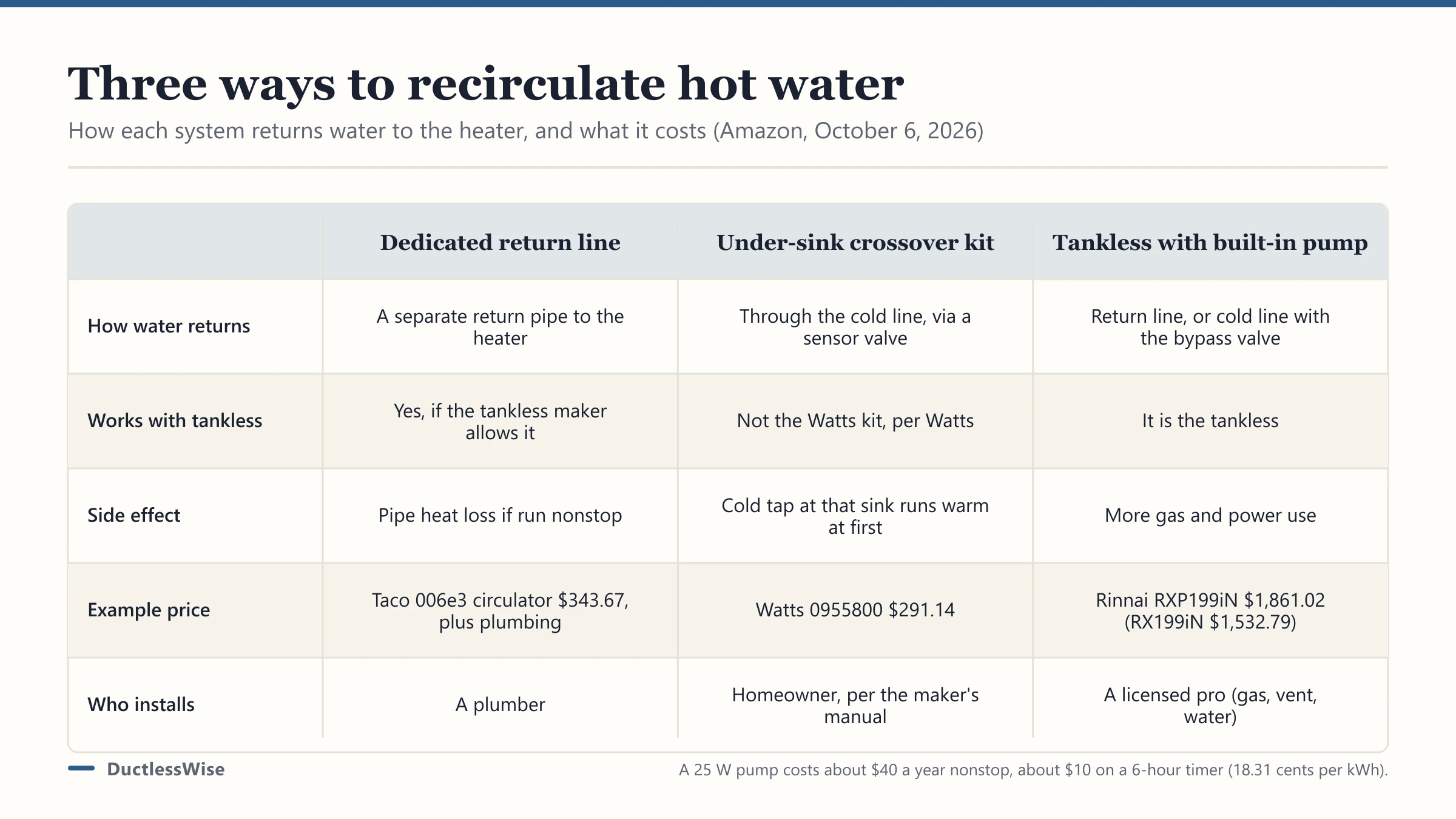
| System | How water returns | Works with tankless? | Side effect | Typical cost, Oct 2026 |
|---|---|---|---|---|
| Dedicated return line with a circulator | A separate return pipe to the heater | Yes, if the tankless maker allows it | Pipe heat loss if run continuously | Circulator such as Taco 006e3 ECM $343.67, plus plumbing |
| Under-sink crossover kit | Through the cold line, via a sensor valve | Not the Watts kit; Watts says it is not designed for tankless | Cold tap at that sink runs warm at first | Watts 0955800 $291.14; 0955805 $278.47 |
| Tankless heater with built-in pump | Return line, or the cold line with the supplied bypass valve | It is the tankless | Recirculation raises gas and power use | Rinnai RXP199iN $1,861.02 vs RX199iN $1,532.79 |
Prices are Amazon listings checked October 6, 2026. Navien’s pump-equipped NPE-240A2 is sold through installers only.
How does an under-sink crossover kit work?
A crossover kit puts the pump at the water heater and a thermostatic sensor valve under the farthest sink, between the hot and cold supply stops. Watts describes its 0955800 system this way: the valve opens when the hot side cools, pushes that water back to the heater through the cold line, and closes when the hot line reaches 98 F.
No return pipe and no outlet under the sink are needed, which is why these kits suit existing homes. The pump plugs into a 120 V outlet near the heater and has a 24-hour programmable dial timer with quarter-hour tabs. The 0955805 listing states a 3-year warranty.
The cost of that convenience is warm cold water. The first seconds from the cold tap at that sink come out near the valve’s closing temperature.
Can you add a recirculating pump to a tankless water heater?
Yes, but not with just any pump. A tankless unit fires only when the flow through it passes its activation threshold: Rinnai lists 0.26 GPM for its Sensei RX series and Navien lists a 0.5 GPM minimum for its NPE-2 series. Watts says its under-sink system is not designed for tankless heaters and “may not work” with one.
The cleaner route is a tankless unit with the pump inside:
- Rinnai RXP199iN. A 4-speed DC pump plus a thermal bypass valve in the box, so a house without a return line can recirculate. Smart-Circ learns the last 7 days of use and schedules the pump. A kit (RX2RXPCK) converts a non-pump RX model.
- Navien NPE-240A2. A pump and a 0.5 gallon buffer tank; the optional NaviCirc valve handles homes without a return line.
- Rheem IKONIC SR series. A built-in pump on the RTGH-SR10i and SR11i.
Mind the warranty. Navien’s residential terms give 15 years on the heat exchanger and 5 on parts with standard or controlled recirculation, but only 5 and 3 years under uncontrolled recirculation. Our gas tankless buying guide compares these models in full, and how tankless water heaters work explains activation flow.
What does a recirculating pump cost to run?
The pump is the small part of the bill. A 25 W pump, the rating on Grundfos’s Comfort System listing, uses about 219 kWh a year running 24 hours a day.
| Pump schedule | Yearly pump energy | Cost at 18.31 cents per kWh |
|---|---|---|
| 24 hours a day | about 219 kWh | about $40 |
| 6 hours a day on a timer | about 55 kWh | about $10 |
| On demand (push button) | minutes of running a day | well under $10 |
The pump rate is the EIA’s July 2026 US residential average. The bigger cost is heat: every foot of hot pipe kept warm loses heat to the house or crawlspace, and the water heater burns gas or electricity to replace it. Navien’s spec sheet notes that energy use increases when its heater runs in recirculation mode. Short schedules and insulated pipe keep that loss down.
Timer, temperature or on-demand: which control is best?
On-demand control wastes the least, a timer is the simple middle ground, and continuous running wastes the most. Rinnai’s Sensei RX brochure notes that California’s Title 24 energy code calls for on-demand push-button recirculation, which its RPB200 button provides.
- On demand. Press a button shortly before you need hot water and the pump runs only until the line is hot. Rinnai’s RPB200 push button works this way.
- Learning schedule. Rinnai’s Smart-Circ times the pump around the household’s last 7 days of use.
- Timer. The Watts dial timer runs the pump during set morning and evening windows.
- Continuous. The pump never stops. Avoid it, and on a Navien it shortens the warranty.
How much water does a recirculating pump save?
Some, though the makers’ figures are claims rather than tests. Watts says its system can save up to 15,000 gallons a year and an average of over 11,000. Real savings depend on how far the farthest fixture is from the heater and how often the household waits at it.
For one far fixture, a small heater at that sink can beat a pump on both water and energy, because nothing keeps a long pipe hot. Our point-of-use water heater guide covers the under-sink tank and mini tankless options.
Who should skip a recirculating pump?
A pump is not worth it in these cases:
- Your fixtures are close to the heater. A short run delivers hot water in a few seconds anyway.
- Only one far sink is the problem. A point-of-use heater serves it without heating the whole pipe.
- You own a tankless heater and want a cheap add-on. Use the maker’s built-in pump or kit instead of a generic crossover kit; see our tankless vs tank comparison for how the wait differs between the two.
- Your water is hard and you have a tankless heater. Recirculation runs more water through the heat exchanger, so plan on regular flushing.
Dedicated return lines and pumps plumbed onto the heater are a plumber’s job under local code. Under-sink kits come with the manufacturer’s installation manual; follow it.
Where do these numbers come from?
- Watts Hot Water Recirculation System 0955800 and 0955805: manufacturer listing text (98 F sensor valve, timer, not designed for tankless, water savings claim, warranty) and prices on Amazon, October 6, 2026.
- Grundfos Comfort System (595916) listing: 25 W pump rating, read October 6, 2026.
- Rinnai, Sensei RX Series brochure (US.2023162): built-in pump, bypass valve, Smart-Circ, activation flow, Title 24 push-button note.
- Navien, NPE-2 specification sheet and NPE-A2 warranty page, read October 6, 2026.
- Rheem, IKONIC SR Series product page, read October 6, 2026.
- EIA Electric Power Monthly Table 5.6.A, July 2026 US residential average.
Frequently asked questions
Quick answers to what readers ask us most
Do hot water recirculating pumps really work?
Yes, for the wait. A pump moves the cooled water sitting in the hot line back toward the heater so hot water is already near the fixture. Watts says its under-sink system delivers hot water in about 15 seconds. The trade-off is energy: the pump uses electricity and the hot pipes lose heat, so most systems run on a timer or on demand.
How much does it cost to run a hot water recirculating pump?
The pump itself is cheap to run. A 25 W pump running around the clock uses about 219 kWh a year, about $40 at the July 2026 US average electricity price of 18.31 cents per kWh, and about $10 on a 6-hour daily timer. The larger cost is the heat lost from pipes kept hot, which depends on pipe length and insulation.
Can you use a recirculating pump with a tankless water heater?
Use one designed for it. Watts says its under-sink system is not designed for tankless water heaters, because a small pump may not reach the heater's minimum activation flow. Tankless units with a built-in pump, such as the Rinnai RXP199iN or Navien NPE-240A2, handle recirculation themselves. Navien cuts its heat exchanger warranty from 15 to 5 years under uncontrolled recirculation, so use a schedule or push button.
Why is my cold water warm after installing a recirculating pump?
Because crossover kits use the cold line as the return path. The sensor valve under the sink pushes cooled hot-side water into the cold pipe until the hot side reaches about 98 F, the closing point Watts lists. The first draw from the cold tap at that sink can come out lukewarm.
Do I need a plumber to install a recirculating pump?
For a dedicated return line or a pump plumbed onto the water heater, yes, in most cases. Under-sink kits are sold for homeowner installation from the manufacturer's manual, but the pump still connects at the water heater outlet. Follow the manual and local plumbing code, and use a plumber if the connections are soldered or the heater is gas-fired and the work touches the gas or vent.