
Solar Mini Splits: AC/DC Hybrids, Panel Math, Real Limits
How AC/DC hybrid solar mini splits like the EG4 12K and 24K work, how many panels they take, what happens at night, and the honest payback math.
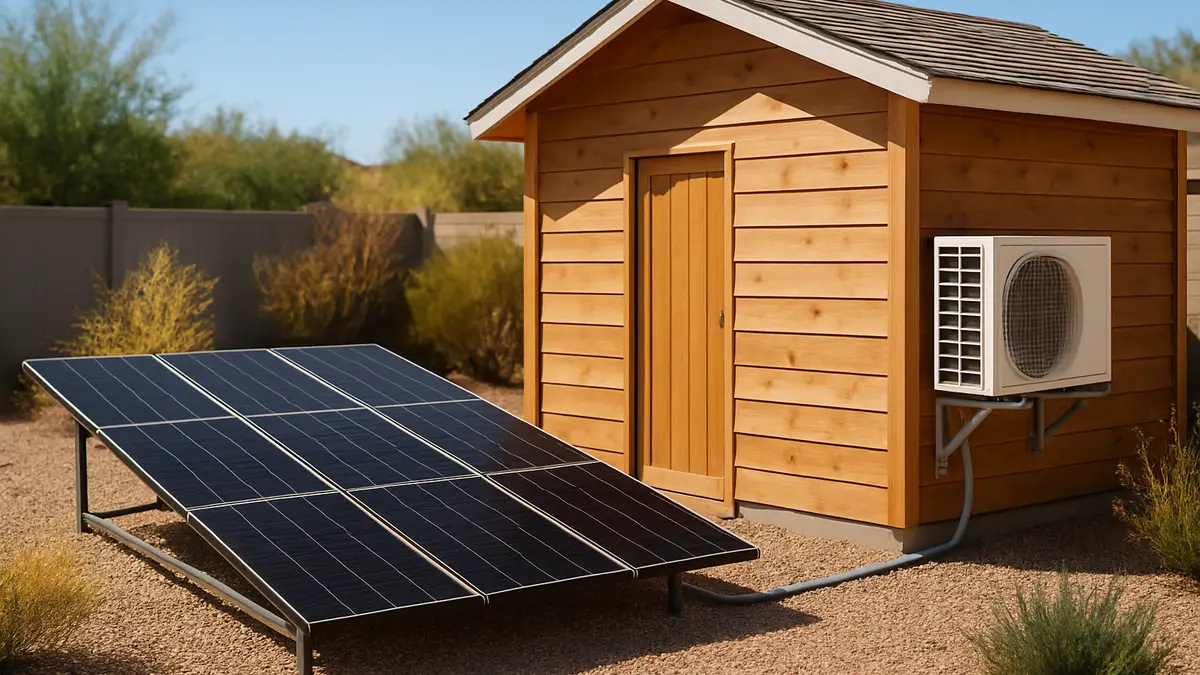
“Solar mini split” covers three different setups, and only one of them is a special product. This page explains the AC/DC hybrid units that take panel power directly, works out how many panels they use, and puts real numbers on the payback, using EG4’s 12K and 24K hybrids because they publish the limits that matter.
What is a solar mini split?
A solar mini split, in the product sense, is an AC/DC hybrid ductless heat pump: the outdoor unit has a DC input that connects straight to a string of solar panels, plus a normal AC connection to your electrical panel. The unit runs on solar DC when the sun is strong, on grid AC when it is not, and blends the two in between. No separate solar inverter or battery is part of the design.
Two other setups get the same label. Any efficient mini split “runs on solar” if the house already has grid-tied rooftop panels, because the panels offset the whole home’s use. And any mini split can run off-grid on a battery bank and inverter large enough to start and carry it. Those are system designs, not products, and this page touches on them only for comparison.
How do EG4’s hybrid solar mini splits compare?
EG4 sells two single-zone hybrids with pre-vacuumed quick-connect line sets, plus two multizone hybrids. Specs below are from EG4’s product pages and the ENERGY STAR mini-split heat pump list, checked October 6, 2026.
| Spec | EG4 12K hybrid | EG4 24K hybrid |
|---|---|---|
| AC supply | 115 V | 208-240 V |
| Solar DC input | 90-380 VDC, up to 1,100 W, 12 A | 150-380 VDC, up to 2,200 W, 20 A |
| Cooling capacity | 12,000 BTU/h (3,000-12,500 range) | 24,000 BTU/h (6,100-25,200 range) |
| SEER2 / EER2 (ENERGY STAR) | 22.5 / 12.6 | 21.0 / 11.7 |
| Rated power draw at full cooling | about 950 W | about 2,050 W |
| Heating range (outdoor) | 5°F to 86°F | 5°F to 86°F |
| Refrigerant | R-32, 27.52 oz in the outdoor unit | R-32, 40.57 oz |
| Line set | 16.4 ft included, 49.2 ft maximum | 16.4 ft included, 82 ft maximum |
| Warranty | 5-year limited | 5-year limited |
The rated power draw is the cooling capacity divided by EER2, our arithmetic from the listed figures. It shows the design intent: each unit’s DC input is sized slightly above what it draws at full cooling, so on a clear midday a full panel string can carry the unit by itself. At part load, which is most of the time for an inverter unit, it draws far less.
EG4 also makes 24K and 36K hybrid multizone condensers (2 to 3 and 2 to 4 heads, 12K minimum head size). Our multi-zone mini split guide covers whether one condenser for several rooms makes sense.
How many solar panels does a solar mini split need?
Enough nameplate watts to fill the DC input on a typical sunny day, wired so the string voltage stays inside the unit’s window. For the EG4 12K that means at least 1,100 W of panels within 90-380 VDC; for the 24K, at least 2,200 W within 150-380 VDC. Panels rarely deliver their nameplate rating, because heat, angle and haze all cut output, so oversizing the array is normal.
EG4’s own kit shows how far: its 24K Hybrid Solar Powered Mini Split Kit pairs the unit with either nine 405 W panels (3,645 W) or seven 450 W panels (3,150 W) and 50 ft of 10 AWG PV wire, against the unit’s 2,200 W input limit. The extra panel capacity keeps the unit on solar longer into the morning and afternoon and on thin-cloud days; at peak, the unit simply uses no more than it can accept.
Panel voltage rises on cold, bright mornings, and a string that sits near the 380 VDC ceiling in summer can exceed it in winter. Working out the string, the wire size and the disconnects is the installer’s job, under the manual and code.
What happens at night and on cloudy days?
The hybrid switches to grid power. EG4 describes the units as supplementing with AC power during low solar or nighttime use, with automatic switching, so comfort does not depend on the weather. It also means solar covers only the hours when sun and demand overlap.
That overlap is the whole economic story. Afternoon cooling in a sunny climate overlaps well. A bedroom cooled mainly at night, a room heated on winter mornings and evenings, or a unit in a cloudy, mild climate overlaps poorly. Heating is the weak case: winter days are short, panels produce least when heating demand peaks before dawn, and the EG4 hybrids list 5°F as the bottom of their heating range.
One more limit to plan around: the DC input powers the mini split. EG4’s spec pages do not describe sending surplus panel output to the rest of the house or the grid, so when the room is satisfied and the compressor slows, assume the unused solar is lost. A grid-tied rooftop system, by contrast, sends every kilowatt-hour somewhere useful.
What does a solar mini split cost, and how fast does it pay back?
In October 2026, Signature Solar listed the EG4 24K Hybrid Mini Split at $2,099.99 and the EG4 24K Hybrid Solar Powered Mini Split Kit, the same unit with panels and PV wire, at $3,254.33. The panels and wire therefore cost $1,154.34. Racking, mounting, the electrician and the permit are extra in both cases; the mini split installation cost guide prices the non-solar side.
Payback depends on how many kilowatt-hours of the unit’s use the panels actually cover each year. The table uses the 2025 US average residential electricity price of 17.30 cents per kWh from the EIA Electric Power Monthly; 2026 year-to-date averaged 18.19 cents.
| Solar kWh the unit uses per year | Bill savings at 17.30¢/kWh | Years to repay $1,154 of panels |
|---|---|---|
| 500 kWh | $86.50 | 13.3 |
| 1,000 kWh | $173.00 | 6.7 |
| 1,500 kWh | $259.50 | 4.4 |
For scale, 1,000 kWh is the 24K hybrid averaging 1,000 W for 1,000 sunny hours, a long hot season in the Southwest or Texas. A shaded or northern site, or a room used mostly at night, sits at the top row or below it. The federal 25D credit no longer helps: the IRS states it is not available for property placed in service after December 31, 2025.
Is a hybrid better than a regular mini split plus rooftop solar?
Not if you already have, or plan, a grid-tied rooftop system. A regular high-efficiency mini split on a home with net-metered solar uses the same sunshine without the hybrid’s limits: surplus goes to the house or the grid, and nights can draw on credits where your utility’s rules allow. Net metering terms vary widely by utility and state, so check yours.
The hybrid makes the most sense where a full rooftop system does not: a cabin, shop or outbuilding with a sunny spot for a few ground-mounted panels, a home where the roof cannot take panels, or a buyer who wants one room’s cooling partly off the grid without a utility interconnection agreement.
What does installing a solar mini split involve?
Two jobs, both partly for licensed trades. The mini split side follows the same path as any DIY unit: mount the heads and condenser, connect the quick-connect lines, and have an electrician run the AC circuit and disconnect. The solar side adds panels, racking, a PV string run to the outdoor unit, and the disconnects and grounding that the National Electrical Code’s photovoltaic article (Article 690) requires; roof-mounted arrays also fall under rapid-shutdown rules.
EG4’s hybrids ship their refrigerant in the outdoor unit and use pre-vacuumed quick-connect line sets rather than lines that carry a charge. Follow EG4’s installation manual for every connection, keep within the 49.2 ft (12K) or 82 ft (24K) maximum line length, and use a licensed electrician for both circuits under a permit. This page does not give wiring instructions. For line lengths and extensions, see the line set guide.
Who should not buy a solar mini split?
Skip the hybrid, or at least run the numbers twice, if one of these fits:
- You need mostly heat. Winter sun is weak and short, and the units’ heating range stops at 5°F.
- The room is used mostly at night. Solar cannot help hours with no sun.
- There is no unshaded spot within reach. Panels in partial shade fall short of the input limit for much of the day.
- You already have net-metered rooftop solar. A standard mini split uses that solar without the hybrid’s waste.
- You want the most comfort per dollar. A plain DIY unit sized right with the sizing calculator often beats a hybrid with a small array; compare models in our best DIY mini splits list.
Frequently asked questions
Quick answers to what readers ask us most
Can a solar mini split run at night?
Only from another power source. AC/DC hybrids like the EG4 12K and 24K switch to grid power when solar output drops, including all night. Running at night without the grid takes a battery and inverter, which the hybrid design does not include.
How many solar panels does a solar mini split need?
Enough to fill its DC input, which is 1,100 W on EG4's 12K and 2,200 W on its 24K, with the string voltage inside the unit's window. EG4's own 24K kit ships 3,150 to 3,645 W of panels to keep output up in morning and haze.
Is a solar mini split worth it?
It can be in sunny places where cooling runs mostly in daytime. At 17.30 cents per kWh, 1,000 kWh of solar-powered cooling a year saves $173, which repays the roughly $1,150 of panels in EG4's kit in under 7 years, before racking and labor.
Do I need an electrician for a solar mini split?
Yes. Solar wiring falls under the National Electrical Code's photovoltaic article, roof arrays add rapid-shutdown rules, and the unit still needs its AC circuit. Have a licensed electrician design and connect both, under a permit.
Is there still a federal tax credit for solar panels on a mini split?
No. The IRS says the Residential Clean Energy Credit is not available for property placed in service after December 31, 2025. Some states and utilities still offer rebates; check yours.