
Multi-Zone Mini Splits: 2, 3, and 4 Zones vs Single Units
When one outdoor unit for several rooms beats separate mini splits: zone limits, head combinations, piping caps, heat at 5°F and dated DIY parts prices.
A multi-zone mini split is one outdoor condenser feeding two to six indoor heads, each with its own thermostat and remote. It is the usual answer for “I want three bedrooms on heat pumps,” but it is not automatically the right one. The trade is fewer outdoor units and circuits against shared risk, a fixed head menu and weaker heating per room. This page sets the two approaches side by side with the manufacturers’ own numbers.
What is a multi-zone mini split?
A multi-zone mini split (also sold as a dual-head, 3-head or 4-head mini split) is a ductless heat pump in which one variable-speed outdoor unit pumps refrigerant to several indoor air handlers through separate line sets. Each room gets its own head and setpoint, while the compressor, outdoor fan and electrical circuit are shared.
Two DIY-oriented families use pre-charged or pre-vacuumed quick-connect lines in October 2026: the MRCOOL DIY 5th Gen Multi-Zone (3 to 6 zones, R-454B) and the EG4 Hybrid Multizone (up to 3 or 4 zones, R-32, with a solar DC input). Professionally installed lines such as MRCOOL Olympus need a technician to vacuum and charge the system.
Which DIY multi-zone systems are on the market?
Five MRCOOL DIY condensers and two EG4 hybrid condensers cover 2 to 6 rooms. Ratings below are the manufacturer’s (MRCOOL catalog V 09.16.26, EG4 product pages) with heating output at 5°F from the ENERGY STAR mini-split heat pump list, checked October 6, 2026.
| Outdoor unit | Max zones | Rated cooling (BTU/h) | SEER2 | HSPF2 | Heat at 5°F (BTU/h) | Max breaker |
|---|---|---|---|---|---|---|
| MRCOOL DIY-MULTI3-18HP230D-O | 3 | 18,000 | 23.9 | 10.0 | 13,300 | 20 A |
| MRCOOL DIY-MULTI4-27HP230D-O | 4 | 26,000 | 23.0 | 9.5 | 18,200 to 19,200 | 25 A |
| MRCOOL DIY-MULTI5-36HP230D-O | 5 | 34,000 | 23.0 | 9.9 | 25,200 | 35 A |
| MRCOOL DIY-MULTI6-48HP230D-O | 6 | 43,000 | 21.8 | 10.0 | 37,000 | 45 A |
| MRCOOL DIY-MULTI6-55HP230D-O | 6 | 47,000 | 22.0 | 10.6 | 46,000 | 45 A |
| EG4 24K Hybrid Multizone (DW3B1-ACDC-24KR2) | 3 | 24,000 | 22.0 | 10.0 | 19,000 | see spec sheet |
| EG4 36K Hybrid Multizone (DW4E1-ACDC-36KR2) | 4 | 36,000 | 22.5 | 10.0 | 29,000 | see spec sheet |
All seven run on 208-230 V. None has a 115 V version, so a multi-zone system always means a 240 V circuit from the panel. All seven carry the ENERGY STAR cold-climate designation.
How many heads, and which sizes, can one outdoor unit run?
Each condenser has a fixed list of allowed head combinations, and the connected heads may add up to more than the condenser’s rating. MRCOOL’s matchup chart lets the 27K four-zone unit run, for example, 9K+9K+9K+9K or 12K+12K+12K, which is 36,000 BTU of heads on a 26,000 BTU condenser. The catalog adds the catch in plain words: if all heads run at once, their combined output will not exceed the outdoor unit’s rating.
The head menu matters more than most buyers expect:
- MRCOOL DIY multi-zone accepts 6K, 9K, 12K, 18K and 24K wall heads (36K on the six-zone units) and the OuttaSight ceiling cassette in 6K to 18K.
- EG4 hybrid multizone heads start at 12K. The 24K condenser runs 12K+12K, 12K+18K, 18K+18K or 12K+12K+12K, and EG4 states at least two heads must be connected.
A 120 sq ft bedroom needs roughly 5,000 BTU on the ENERGY STAR sizing chart, so a 12K-minimum head menu oversizes small rooms by more than double. Size every room on its own with the mini split sizing calculator, then pick a condenser whose chart contains that exact combination.
Multi-zone or several single-zone mini splits: which is better?
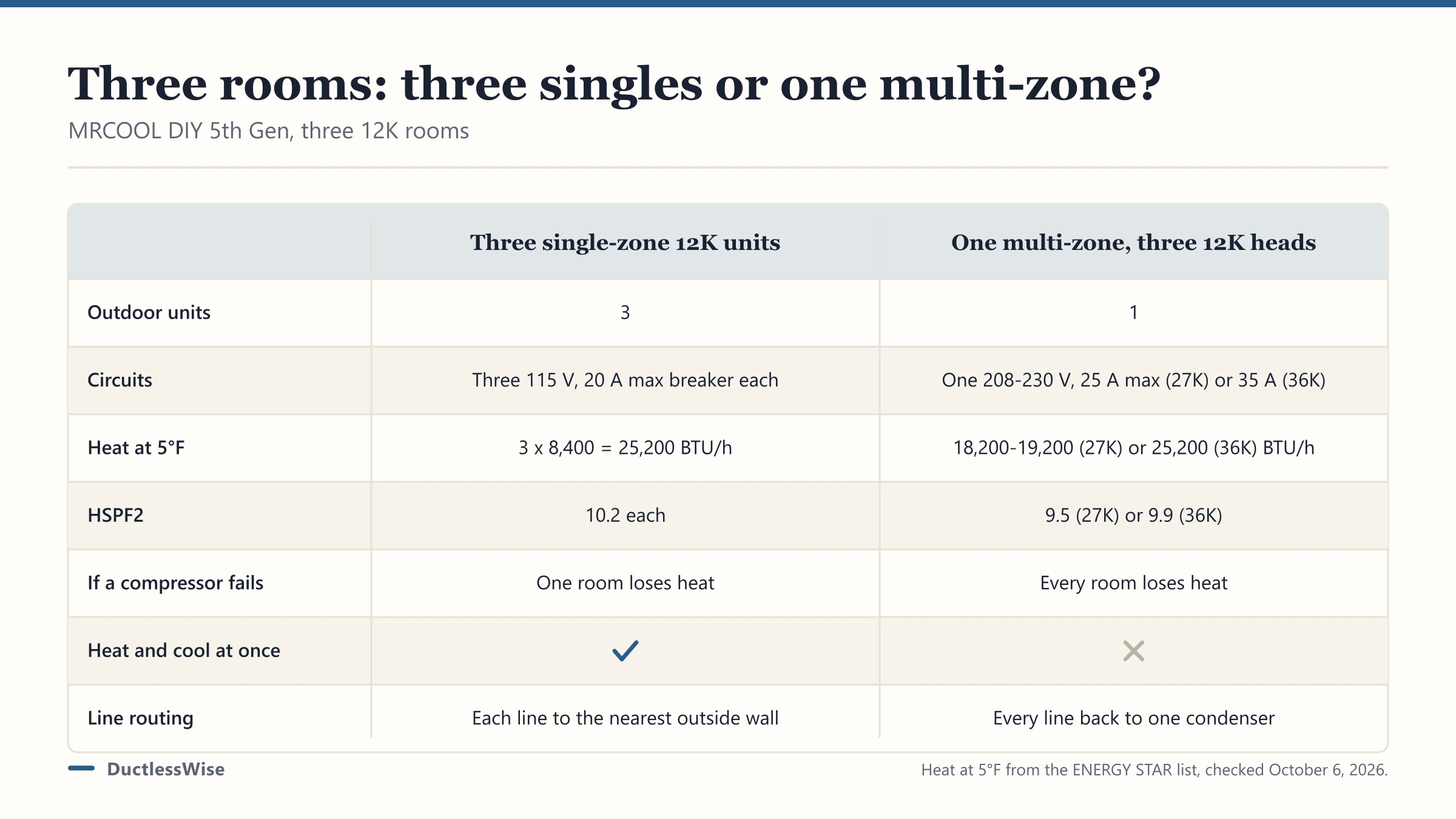
For two or three rooms, separate single-zone units usually win on heating and resilience; a multi-zone wins on outdoor space, wiring and equipment price. The comparison below uses MRCOOL’s DIY 5th Gen single-zone units and its DIY multi-zone condensers for three 12K rooms.
| Factor | Three single-zone 12K units | One multi-zone condenser, three 12K heads |
|---|---|---|
| Outdoor units on the wall or pad | 3 | 1 |
| Circuits | Three 115 V circuits, 20 A max breaker each | One 208-230 V circuit (25 A max on the 27K, 35 A on the 36K) |
| Heating at 5°F (ENERGY STAR) | 3 x 8,400 = 25,200 BTU/h | 18,200 to 19,200 BTU/h on the 27K, 25,200 on the 36K |
| HSPF2 (heating efficiency) | 10.2 each | 9.5 (27K) or 9.9 (36K) |
| One compressor fails | One room loses heat | Every room loses heat |
| Mixed modes | Each unit heats or cools independently | All running heads share heat or cool mode |
| Line routing | Each line goes to the nearest outside wall | Every line returns to one condenser location |
The heating row is the one that decides cold-climate homes. Three DIY 12K singles deliver 25,200 BTU/h at 5°F between them; to match that with one condenser you need the five-zone 36K unit, not the four-zone 27K that the head count suggests.
Why do small rooms run less efficiently on a multi-zone system?
A small room on a big compressor wastes energy in mild weather because the compressor cannot slow down far enough to match one small head. When only a 6K or 9K bedroom head calls for heat on a 36K condenser, the compressor runs near its minimum speed or cycles on and off, which costs efficiency and comfort.
The published ratings do not show this. SEER2 and HSPF2 for a multi-zone system are tested with a rated indoor combination, not with one small head running alone. In practice, homes where bedrooms run at night while living areas sit idle spend many hours in exactly that one-small-head condition. That is one reason MRCOOL’s single-zone 9K (HSPF2 11.5) out-rates every one of its multi-zone condensers (HSPF2 9.5 to 10.6) on heating efficiency.
How far can each head be from the outdoor unit?
Multi-zone piping limits are tighter on height than single-zone limits. MRCOOL’s DIY multi-zone installation manual sets these caps; the single-zone column is from the DIY 5th Gen single-zone manual.
| Limit | DIY multi-zone | DIY 5th Gen single-zone |
|---|---|---|
| Longest run to one head | 75 ft | 75 ft |
| Total of all runs | 172 ft (3-zone), 221 ft (4 to 6 zones) | Not applicable |
| Height difference, indoor to outdoor | 33 ft | 49.2 ft (9K, 12K), 65.6 ft (18K), 75 ft (24K, 36K) |
| Height difference between heads | 24 ft | Not applicable |
| Minimum run | 9.8 ft | Not stated (24.6 ft set in the box) |
MRCOOL’s multi-zone manual is built around a standard 24.6 ft line set per head; longer runs take additional pre-charged sets. MRCOOL sells DIY sets in 11.5, 16, 25, 35 and 50 ft lengths with couplers to join two, and its manual warns the quick-connect fittings are designed to be connected once; reconnecting a used set voids the warranty. A head on an interior wall needs its line routed through an attic, basement or crawlspace back to the condenser, which is where most multi-zone plans grow longer than expected. Our mini split line set guide covers lengths, couplers and covers.
What does a DIY multi-zone system cost?
A two-room DIY multi-zone system runs about $2,200 to $3,500 in equipment, before the electrician, and a four- or five-room system about $6,000. MRCOOL sells through retailers; the prices below are Sylvane’s listings for MRCOOL’s DIY 5th Gen bundles and Signature Solar’s for EG4 parts, both checked October 6, 2026.
| Multi-zone option | Price | Same rooms with single-zone units |
|---|---|---|
| MRCOOL DIY 5th Gen dual zone, 9K + 9K (18,000 BTU condenser) | $2,619.00 | Two DIY 5th Gen 9K at $2,029.00 each: $4,058.00 |
| MRCOOL DIY 5th Gen dual zone, 12K + 12K (27,000 BTU condenser) | $3,478.00 | Two DIY 5th Gen 12K 115 V at $1,880.00 each: $3,760.00 |
| MRCOOL DIY 5th Gen five zone, 5 x 9K (48,000 BTU condenser) | $5,888.00 | Five 9K singles: $10,145.00 |
| MRCOOL DIY 5th Gen quad zone, 4 x 12K (48,000 BTU condenser) | $5,984.00 | Four 12K singles: $7,520.00 |
| EG4 24K Hybrid Multizone outdoor unit + two 12K heads | $1,599.99 + $599.98 = $2,199.97 | Two EG4 12K 115 V single-zone units at $1,299.99: $2,599.98 |
On price, multi-zone wins, and the gap grows with the number of small rooms. Two cautions before you treat the table as final. First, confirm what each listing includes: MRCOOL’s single-zone DIY 5th Gen kits come with a 25 ft pre-charged line set, and a multi-zone bundle may or may not include one per head. Second, the price gap buys you less heat in winter, as the comparison above shows. Add the electrician’s circuit and disconnect, a pad or wall bracket and line set covers; the mini split installation cost guide prices those lines and the professionally installed alternative.
What does a multi-zone install involve, and what stays a pro job?
Mounting heads and connecting pre-charged lines is the DIY part; the electrical work is not. MRCOOL’s multi-zone manual states all wiring must comply with local and national codes and be installed by a licensed electrician, which covers the 208-230 V circuit and the outdoor disconnect. Follow the installation manual for every step, pull the permit your town requires, and stop and call a pro if a line set leaks or a fitting will not seat.
Two manual details catch people out. First, R-454B is a mildly flammable (A2L) refrigerant, and the manual includes a minimum room floor area table tied to the system’s refrigerant charge; check it before putting a head in a small room or closet. Second, the outdoor unit needs the wall and obstacle clearances the manual lists for its cabinet size. This page does not give wiring or refrigerant instructions; the manual, local code and a licensed electrician do.
Who should not buy a multi-zone mini split?
Skip multi-zone, or at least price the single-zone alternative first, if one of these fits:
- You heat through real winters with no backup. Matching the 5°F output of separate single-zone units takes a larger condenser, and one failure leaves every room cold.
- Your rooms are small. If most heads would be 6K or 9K on a large condenser, small single-zone units or one ducted unit run more efficiently.
- Rooms need opposite modes. A sun-baked office that wants cooling while a north bedroom wants heat cannot have both from one standard condenser.
- The rooms are on opposite sides of the house. Long interior line runs hit the 33 ft height and 221 ft total caps faster than expected.
- You want one quiet unit for an open floor plan. One larger single-zone head, or a ducted mini split or ceiling cassette, serves an open area better than several heads.
How should you decide between one system and several?
Start with room-by-room loads, not a whole-house number. Run each room through the sizing calculator, list the head sizes, and check whether a single condenser’s matchup chart contains that combination and covers your heating at the local design temperature. If the multi-zone option needs a bigger condenser to match the heat of separate singles, or forces 12K heads into small bedrooms, separate units are usually the better buy.
For the wider question of whether mini splits suit the house at all, read mini split pros and cons. For single-room systems ranked by spec, see the best DIY mini splits. For a whole house, a Manual J load calculation by a professional is still the reliable starting point.
Frequently asked questions
Quick answers to what readers ask us most
How many rooms can one multi-zone mini split serve?
Two to six. MRCOOL's DIY multi-zone condensers handle 3, 4, 5 or 6 heads depending on the model, and EG4's hybrid multizone units take up to 3 (24K) or 4 (36K). Both need at least two heads connected.
Can one room heat while another room cools on a multi-zone system?
No, not on standard DIY multi-zone heat pumps. MRCOOL's manual says heat mode takes precedence: once one head runs in heat, the others can only heat or stop. Only pricier heat-recovery systems mix modes.
Can the indoor heads add up to more BTU than the outdoor unit?
Yes, within the manufacturer's combination chart. MRCOOL's 27K four-zone unit accepts up to 36,000 BTU of heads, but when all run at once their combined output never exceeds the outdoor unit's rating.
Is a multi-zone mini split more efficient than single-zone units?
Not usually for heating. MRCOOL's DIY multi-zone condensers rate 9.5 to 10.6 HSPF2, while its 9,000 and 18,000 BTU single-zone DIY units rate 11.5. Small rooms on a large compressor also run less efficiently in mild weather.
Do I need a different line set for each head?
Yes. Each head gets its own pre-charged line set, sized to that head, run back to the one outdoor unit. MRCOOL caps each run at 75 ft and the whole system at 172 ft (3-zone) or 221 ft (4 to 6 zones).