
Mini Split for a Garage: Size, Insulation, and Best Picks
What size mini split a one- or two-car garage needs with and without insulation, which DIY units run on 115 V, and how to handle mounting and condensate.
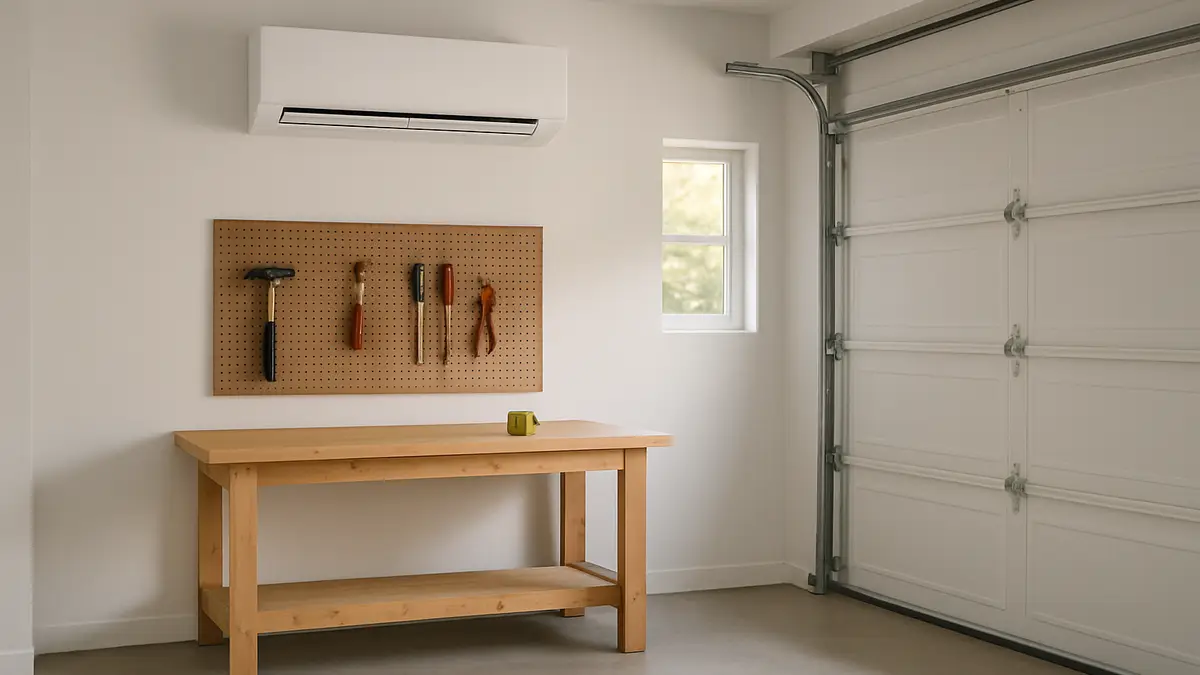
A garage is the hardest room in most houses to heat and cool: a big door with little insulation, a concrete slab, and often no ceiling insulation at all. A ductless mini split handles it well, but only if it is sized for the garage you actually have. This page runs real garage sizes through the DuctlessWise sizing calculator and matches the results to DIY models.
What size mini split does a garage need?
A one-car garage usually needs 9,000 to 12,000 BTU and a two-car garage 18,000 to 24,000 BTU, depending mostly on insulation. The figures below come from our calculator with a 9 ft ceiling, average sun, one person working in the space, and climate zone 4 (New York City, St. Louis). They start from the ENERGY STAR room sizing chart and apply the calculator’s labelled garage and insulation factors.
| Garage | Insulation (walls, ceiling, door) | Cooling load | Recommended size |
|---|---|---|---|
| One-car, 12 x 24 ft (288 sq ft) | Good | 7,088 BTU/h | 9,000 BTU |
| One-car, 12 x 24 ft | Average | 9,450 BTU/h | 12,000 BTU (9,000 close) |
| One-car, 12 x 24 ft | Poor | 11,340 BTU/h | 12,000 BTU |
| Two-car, 24 x 24 ft (576 sq ft) | Good | 14,175 BTU/h | 18,000 BTU |
| Two-car, 24 x 24 ft | Average | 18,900 BTU/h | 24,000 BTU (18,000 close) |
| Two-car, 24 x 24 ft | Poor | 22,680 BTU/h | 24,000 BTU |
“Close” means the load lands within 5 percent of the smaller size, where a slightly small inverter unit that runs longer is often the better choice. Your own garage will differ: enter its size, ceiling height, climate zone and insulation in the sizing calculator and it shows every factor it applied.
Why insulate the garage before buying a mini split?
Insulation changes the size, the circuit and the efficiency of the unit you need, so it is the first purchase, not the last. The calculator adds 20 percent for a garage unless its insulation is good, because of the door and slab. In the two-car example, going from average to good insulation drops the recommendation from 24,000 to 18,000 BTU.
That one step down matters beyond the price tag. In MRCOOL’s DIY 5th Gen line, the 18K rates 11.5 HSPF2 and carries the ENERGY STAR cold-climate designation, while the 24K rates 9.5 HSPF2 and does not. The 18K’s outdoor unit takes a 20 A maximum breaker against the 24K’s 25 A. Price weatherstripping for the door, an insulation kit for the door panels and ceiling insulation against that jump between sizes before you order the unit.
Can a garage mini split run on 115 V?
Yes, up to 12,000 BTU. MRCOOL’s DIY 5th Gen 9K and 12K run on 115 V, as does EG4’s 12K single-zone heat pump; everything larger in both brands needs 208-230 V. That makes 115 V a realistic option for most one-car garages and well-insulated small shops, not for a typical two-car garage.
“115 V” does not mean plugging into the outlet by the workbench. MRCOOL’s brochure lists an 18 A minimum circuit ampacity and a 20 A maximum breaker for the 115 V outdoor units, and its installation manual states electrical work must be done by a licensed electrician. Plan a dedicated circuit and an outdoor disconnect, following the manual and local code. If your garage subpanel is already full, that changes the electrician’s quote more than the voltage does.
Which DIY mini splits suit a garage?
The best garage pick is the smallest model that covers your load at your voltage and still carries enough heat at your winter design temperature. Specs below are from the MRCOOL catalog (V 09.16.26), the EG4 product page and the ENERGY STAR mini-split heat pump list, checked October 6, 2026.
| Model | Size | Voltage | SEER2 | Heat at 5°F | Lowest heating temperature | Price, Oct 6 2026 |
|---|---|---|---|---|---|---|
| MRCOOL DIY 5th Gen 9K | 9,000 | 115 V | 23.6 | 7,300 BTU/h | -13°F | $2,029.00 (Sylvane) |
| MRCOOL DIY 5th Gen 12K | 12,000 | 115 V | 23.5 | 8,400 BTU/h | -13°F | $1,880.00 (Sylvane) |
| EG4 12K single-zone heat pump | 12,000 | 115 V | see spec sheet | not listed | 5°F | $1,299.99 (Signature Solar) |
| MRCOOL DIY Hyper Heat 12K | 12,000 | 208-230 V | 23.5 | 11,000 BTU/h | -22°F | $2,532.00 with 25 ft line set (Sylvane) |
| MRCOOL DIY 5th Gen 18K | 18,000 | 208-230 V | 22.5 | 12,800 BTU/h | -13°F | $2,609.00 (Sylvane) |
| MRCOOL DIY Hyper Heat 18K | 18,000 | 208-230 V | 21.2 | 18,000 BTU/h | -22°F | $3,173.00 with 25 ft line set (Sylvane) |
| MRCOOL DIY 5th Gen 24K | 24,000 | 208-230 V | 22.7 | 16,100 BTU/h | -13°F | $2,574.99 (Sylvane) |
Prices are sale prices on the day we checked and move often; on October 6 the 24K happened to list below the 18K. That changes the purchase price, not the case for insulating: the 18K still heats more efficiently (11.5 against 9.5 HSPF2), takes a smaller breaker and keeps the cold-climate rating.
For a heated garage in a cold climate, the Hyper Heat models stand out: the 18K Hyper Heat keeps its full 18,000 BTU/h at 5°F on its ENERGY STAR listing, against 12,800 for the standard 18K. In the two-car, well-insulated example in zone 5 (Chicago, Denver), the calculator puts the heating load at 10,206 BTU/h, which the standard 18K covers. For the full DIY 5th Gen lineup and its limits, read our MRCOOL DIY review; for other brands, the best DIY mini splits comparison.
Where should the indoor and outdoor units go?
Put the indoor head high on a wall where the air can blow down the length of the garage, away from the door opening and where cars park. MRCOOL’s DIY 5th Gen manual calls for at least 5.9 ft from the floor to the bottom of the indoor unit, 5.9 inches above it and 4.72 inches on each side, which usually means the back wall above a workbench.
Outside, the condenser can sit on a ground pad or stand, or on a wall bracket bolted to the structure; MRCOOL’s manual allows either, with the unit level and anchored. A wall bracket lifts the unit above snow and away from cars, bikes and mowers, and costs little. On October 6, 2026, Signature Solar listed EG4’s wall bracket kit at $19.95 (rated for 352 lb), and Sylvane listed Senville’s wall bracket at $59.99 and its ground stand at $59.00. Where heavy snow is common, the manual says to build a shelter above the unit without blocking its airflow. Keep the run from head to condenser within the line set you own; the line set guide covers lengths and covers.
How do you handle condensate in a garage?
A mini split head pulls water out of the air while cooling, and that water has to go somewhere downhill. On an outside wall, the drain hose leaves with the line set through a wall hole drilled at a slight downward slope toward the outside, and gravity does the rest. Problems start when the head sits on an interior wall, or the only exit point would drip onto a walkway or driveway that freezes in winter.
That is where a mini split condensate pump comes in: a small pump, often sold to fit inside a line set cover or under the head, that lifts water to a drain or out of the wall. It needs power and its own float switch, so mount and wire it as its manual and your electrician direct.
The outdoor unit drains too. In heat mode it defrosts its coil periodically on cold days, and the meltwater leaves through its base pan. MRCOOL’s manual warns that in cold climates the outdoor drain hose should run as close to vertical as possible, because slow-draining water can freeze in the hose and flood the unit.
What do building codes say about conditioning a garage?
Codes vary by town, so ask your building department before you buy, but three points come up almost everywhere. First, the electrical circuit and disconnect need a permit and, per MRCOOL’s manual, a licensed electrician. Second, codes generally do not let a house’s central heating and cooling system share air with an attached garage, because of car exhaust; a ductless head that serves only the garage avoids that problem. Third, some jurisdictions treat a garage you heat and cool as conditioned space under the energy code, which can bring insulation requirements with it.
None of this is legal advice, and inspectors interpret the same code differently. A five-minute call before the permit saves a failed inspection after.
How do you keep a garage mini split running well?
Garages are hard on the indoor unit’s filters: sawdust, drywall dust, lint from a dryer and road grit all collect in the mesh. Check the filters every two weeks while you are cutting or sanding, not just once a month. Keep solvents and paint spraying away from the head’s intake, and keep the outdoor coil clear of leaves, snow and anything stacked against it. Our mini split maintenance guide covers filter and coil cleaning that owners can do with the power off.
Who should not put a mini split in the garage?
A mini split is the wrong buy for some garages. Skip it, or fix the building first, if one of these fits:
- The door is open for hours every day. No mini split keeps up with an open 16 ft door.
- The garage is uninsulated and you use it two hours a week. You would pay for a 24,000 BTU system and a 230 V circuit to condition a space you rarely occupy.
- You rent. The circuit, the wall hole and the outdoor bracket are permanent changes.
- You want it to also cool the house. A garage head serves the garage only; a house-sized load needs its own plan.
For the full budget, including the electrician, pad or bracket and line set cover, see the mini split installation cost guide.
Frequently asked questions
Quick answers to what readers ask us most
Can I put a mini split in an uninsulated garage?
You can, but you pay for it twice: a bigger unit up front and higher bills after. In our calculator a 576 sq ft garage with average insulation needs 24,000 BTU, and the same garage well insulated needs 18,000.
Will a mini split heat a garage in winter?
Yes, within its range. MRCOOL rates its DIY 5th Gen units to heat down to -13°F and its Hyper Heat units to -22°F, but output falls in the cold: the DIY 18K delivers 12,800 BTU/h at 5°F on its ENERGY STAR listing.
Can I plug a 115 V mini split into a garage outlet?
Do not plan on it. MRCOOL's 115 V DIY units list an 18 A minimum circuit ampacity and a 20 A maximum breaker, and the manual calls for a licensed electrician. Budget for a dedicated circuit.
Do I need a condensate pump for a garage mini split?
Only if the indoor head cannot drain downhill to the outside. A head on an outside wall drains by gravity through its wall hole. A head on an interior wall, or one whose drain would exit onto a walkway, needs a pump or a different route.
Should the outdoor unit go on a wall bracket or a pad?
A wall bracket keeps the unit above snow and out of the way of cars and mowers; a ground pad or stand is easier to service. MRCOOL's manual allows either, bolted down, with a shelter where heavy snow is common.