
Ducted Mini Split vs Ceiling Cassette vs Wall Mount
Ducted mini split vs ceiling cassette vs wall mount: cavity depth, efficiency penalty, drain route, noise, and which indoor styles you can install yourself.
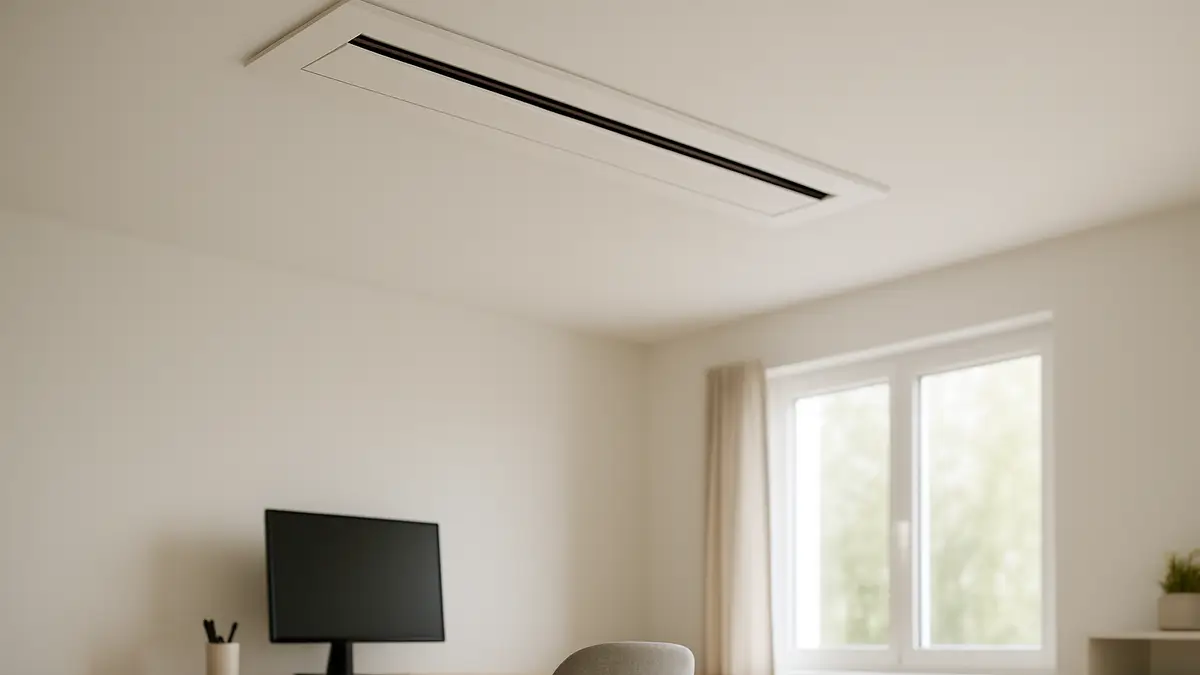
Once you have decided on a mini split, the next choice is the indoor unit. The outdoor condenser can be identical while the indoor side changes cost, efficiency, noise and who is allowed to install it. This page compares the four styles on real dimensions and ratings, using MRCOOL’s catalog (V 09.16.26) because it sells all of them under one brand, DIY and pro.
What are the four indoor unit styles?
A mini split indoor unit comes in four common forms: a wall-mounted head high on a wall, a ceiling cassette recessed into the ceiling with a grille below, a ducted (concealed or slim ducted) air handler hidden in a ceiling, attic or closet and connected to short ducts, and a floor console that sits low on a wall like a radiator. All four are the same heat pump. They differ in where the coil and fan live and how the air reaches the room.
| Style | Visible in the room | Typical spot | DIY quick-connect version (MRCOOL, Sept 2026) |
|---|---|---|---|
| Wall-mounted head | Whole unit | High on an outside wall | Yes, 6K to 36K |
| One-way ceiling cassette | Slim grille | Between ceiling joists | Yes, OuttaSight 6K to 18K |
| Four-way ceiling cassette | Square grille | Ceiling, often a 2x2 grid | No, Olympus (pro install) |
| Slim ducted (ceiling recessed) | Supply and return grilles only | Ceiling cavity, soffit, attic | No, Olympus (pro install) |
| Full-size ducted air handler | Registers only | Closet, attic, basement | Yes, DIY Hybrid Air Handler 24K and 36K |
| Floor console | Whole unit | Low on a wall | Not in the DIY catalog |
How much ceiling depth does a cassette or ducted unit need?
A recessed unit needs a cavity at least as deep as its body, and many ceilings are shallower than people assume. A 2x8 joist is 7.25 inches deep, a 2x10 is 9.25 inches, and a 2x12 is 11.25 inches. Joists at 16 inches on center leave 14.5 inches between them.
| Indoor unit (MRCOOL catalog V 09.16.26) | Body size, W x D x H (in) | Clears 2x8 depth (7.25 in)? | Clears 2x10 depth (9.25 in)? | Fits between 16 in joists? |
|---|---|---|---|---|
| DIY OuttaSight one-way cassette, 6K to 18K | 50.3 x 13.1 x 8.9 | No | Yes, on paper | Yes (13.1 in) |
| Olympus four-way cassette, 9K to 18K | 22.44 x 22.44 x 9.65 | No | No, needs 2x12 or a drop | No |
| Olympus four-way cassette, 24K | 32.68 x 32.68 x 8.07 | No | Yes, on paper | No |
| Olympus slim ducted, 9K and 12K | 27.56 x 19.92 x 7.87 | No | Yes, on paper | No |
| Olympus slim ducted, 24K | 39.37 x 29.53 x 9.65 | No | No | No |
The DIY cassette’s 13.1-inch depth is what lets MRCOOL say it fits between 16-inch joists: 13.1 inches into a 14.5-inch bay. “On paper” matters: duct collars, the drain connection and hanging hardware add space, so confirm against the installation template before you buy. Four-way cassettes span more than one bay, which means cutting or heading off a joist, a structural job.
Does a ceiling or ducted unit cost efficiency?
Yes. On the same outdoor unit, the wall head rates higher on SEER2 (cooling) in every 5th Gen DIY pairing ENERGY STAR lists for MRCOOL. Figures below are from the ENERGY STAR mini-split heat pump list and the MRCOOL catalog, checked October 6, 2026.
| Outdoor unit | With wall head (SEER2 / HSPF2) | With other indoor unit (SEER2 / HSPF2) |
|---|---|---|
| DIY 5th Gen 18K | 22.5 / 11.5 | DIY cassette: 21.4 / 11.5 |
| DIY Hyper Heat 12K (230 V) | 23.5 / 10.0 | DIY cassette: 22.2 / 10.8 |
| DIY Hyper Heat 18K (230 V) | 21.2 / 11.0 | DIY cassette: 19.8 / 12.2 |
| DIY 5th Gen 24K | 22.7 / 9.5 | DIY Hybrid ducted air handler: 19.4 / 9.1 |
| DIY 5th Gen 36K | 18.0 / 8.5 | DIY Hybrid ducted air handler: 15.7 / 8.2 |
The cooling penalty runs 1 to 3 SEER2 points. Heating is mixed: two of the three cassette pairings actually rate higher on HSPF2. Ducted pairings lose on both, and real ducts add losses the rating does not count; ENERGY STAR estimates a typical home loses 20 to 30 percent of the air moving through its ducts to leaks and poor connections.
What is a ducted mini split, and when does it make sense?
A ducted mini split is a mini split whose indoor air handler hides out of sight and pushes air through short supply ducts to one or more registers, with a return grille pulling air back. It makes sense when you want two or three adjacent rooms on one unit without a head on any wall, or when a finished room has no good wall for a head.
Two very different products share the name:
- Slim ducted (low-profile, ceiling recessed) units, such as the DUCT-09HP to DUCT-24HP heads for MRCOOL’s Olympus multi-zone condensers, 7.87 to 9.65 inches tall. They are built for short, low-resistance duct runs in a soffit or attic, usually serving one to three rooms. MRCOOL’s catalog lists them for professional installation.
- Full-size air handlers on mini split condensers, such as MRCOOL’s DIY Hybrid Air Handler (DIY-24-HP-MUAH-230D25-O and DIY-36-HP-MUAH-230D25-O). It is a 45 to 49 inch tall multi-position cabinet (upflow, downflow or horizontal) that connects to existing ductwork, uses quick-connect lines to the DIY 5th Gen 24K or 36K condenser, includes a smart thermostat, and is rated for up to 1,500 sq ft.
Can you reuse existing ductwork with a ducted mini split?
Sometimes, but treat it as a design question, not an assumption. Old ducts were sized for a furnace or central AC’s airflow; the DIY Hybrid Air Handler moves about 760 CFM on high (24K) and 1,083 CFM on high (36K) per the catalog, and a slim ducted unit moves far less against far less resistance. Undersized or leaky ducts cut airflow, which cuts capacity and raises noise.
Duct sizing for a new or reused system follows ACCA Manual D, and the load behind it follows Manual J. Ask the contractor who checks your ducts for both. Sealing joints that run through an attic or crawlspace is cheap insurance given the 20 to 30 percent leakage ENERGY STAR cites for typical systems. This page does not cover duct or refrigerant installation steps; follow the manual and use licensed trades for that work.
How do the styles compare on drain route, noise and filters?
Each style solves condensate, sound and filter access differently, and those details decide daily life with the system more than the spec sheet does.
| Factor | Wall head | Ceiling cassette | Slim or full ducted |
|---|---|---|---|
| Condensate | Gravity drain out through the wall hole | Center of the room; drain pump often needed (MRCOOL lists it as optional) | Drain pan in the attic or closet; pump or gravity line, and an overflow safety switch is wise |
| Quietest listed setting (MRCOOL) | 18 dB(A), DIY 12K | 24 dB(A), DIY cassette 12K | Air handler noise moves into the ducts and registers |
| Loudest listed setting | 43 dB(A), DIY 12K turbo | 41 dB(A), DIY cassette 12K turbo | 44 dB(A), DIY Hybrid 24K high |
| Filter access | Lift the front panel | DIY cassette lowers its filter panel by remote | At the return grille or inside the cabinet, often in an attic |
| Electrical | Fed through the interconnect cable from the outdoor unit | Same as a wall head; check the wiring diagram | The DIY Hybrid Air Handler lists its own 208-230 V indoor supply (15 A max fuse) |
Filter cleaning is the job owners skip most, and it matters more on hidden units because you cannot see dust building up. Our mini split maintenance guide covers cleaning intervals for each style.
Which style should you pick?
Pick by the room, not the look. These rules cover most homes:
- One room with a usable outside wall: wall head. Cheapest, highest rated, simplest drain, fully DIY-compatible. Size it with the mini split sizing calculator.
- A finished room where a wall head is unacceptable, joists 2x10 or deeper: DIY one-way cassette on an 18K or Hyper Heat 12K condenser, with the drain route solved first.
- Two or three adjacent rooms, attic or soffit above them: slim ducted unit, professionally installed, or one head per room on a multi-zone system.
- Replacing an old furnace and AC with good existing ducts: a full-size ducted air handler, after a contractor confirms the ducts can carry the airflow. If you are weighing it against a new furnace, see heat pump vs furnace.
- Attic kneewall room or a wall full of windows: a floor console from a professional-install line.
Who should not choose a ceiling or ducted unit?
Skip the hidden options if you are on a tight budget, if your ceiling is framed with 2x8s or trusses you cannot cut, or if you will not keep up with filter cleaning in an attic. Skip them too if you plan to do the work yourself and want everything on quick-connect lines: in MRCOOL’s catalog only the one-way cassette and the Hybrid Air Handler qualify, and the Hybrid Air Handler still needs ducts built or verified by a pro.
Equipment is not always the expensive part: on October 6, 2026, Sylvane listed Pioneer’s Quantum Ultra 12,000 BTU ceiling cassette mini split, a conventional vacuum-and-flare system, at $1,458.00. Cutting joists, building soffits, a drain pump, running ducts and adding the circuit are what push hidden units past wall heads, and they are work for licensed trades under local code. For what that adds to the bill, see the mini split installation cost guide; for single-room systems ranked on spec, see the best DIY mini splits; and if you are still deciding whether a mini split beats central air at all, read mini split pros and cons.
Frequently asked questions
Quick answers to what readers ask us most
Is a ducted mini split better than a ductless one?
It looks cleaner and can serve two or three nearby rooms from one hidden unit, but it costs more, needs duct design and usually a pro. On the same condenser, a wall head rates higher on SEER2 than ceiling or ducted styles.
Can I install a ceiling cassette mini split myself?
MRCOOL sells a DIY one-way ceiling cassette (OuttaSight) that uses quick-connect lines and fits between 16-inch-on-center joists. Four-way cassettes and slim ducted units in its catalog are for professional installation.
How much ceiling space does a ceiling cassette need?
MRCOOL's DIY one-way cassette body is 8.9 inches tall and its four-way Olympus cassettes are 8.07 to 9.65 inches. A 2x10 joist is 9.25 inches deep; a 2x8 is only 7.25, so shallow ceilings need a soffit or drop.
Do ceiling cassettes need a condensate pump?
Often. A wall head drains by gravity through its wall hole, but a ceiling unit sits in the middle of the room. MRCOOL lists the cassette drain pump as optional, so plan the condensate route before you cut the ceiling.
Is there a DIY floor-mounted mini split?
Not from MRCOOL's DIY line as of its September 2026 catalog. Floor consoles exist from professional-install brands and suit attic kneewall rooms and spaces with no high wall.