
Window Heat Pumps: Real Models, Cold Limits, vs Mini Splits
Window heat pumps in 2026: which real models heat in winter, where most shut off (41 F), running cost math, and how they compare with a 9k DIY mini split.
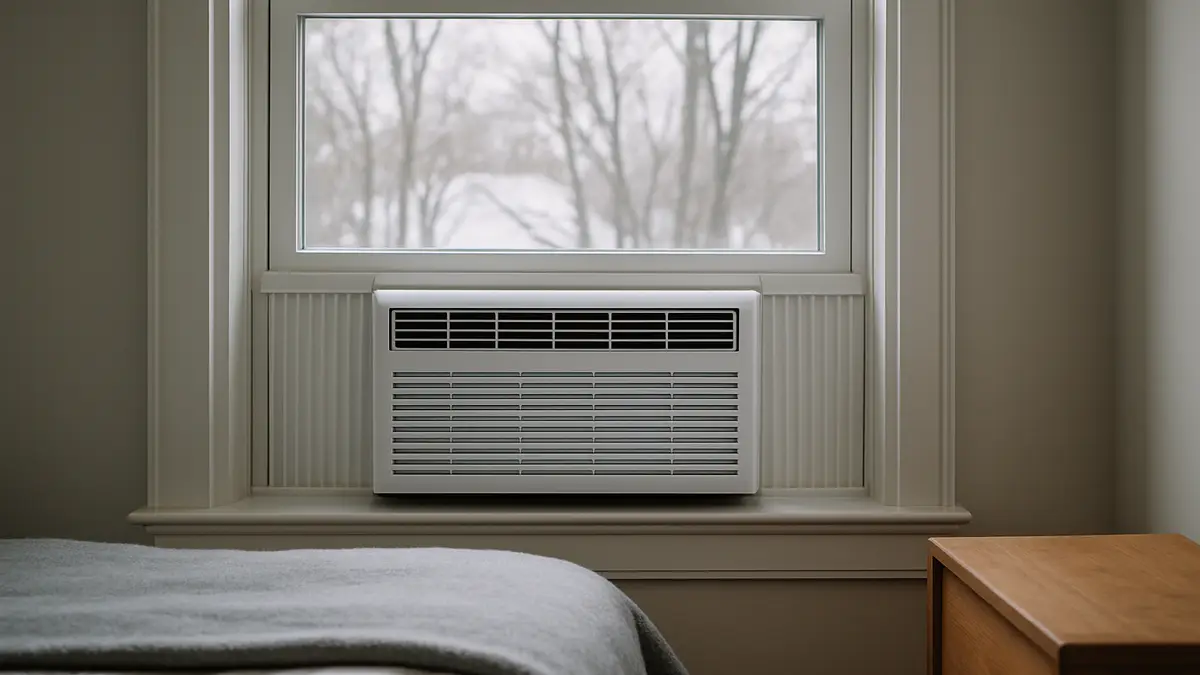
A window heat pump is the most DIY heat pump there is: it sits in a window, plugs into an outlet, and needs no refrigerant work, wall hole or permit for the unit itself. The trouble is the word “heat”. Most window units sold with heat either use an electric heater or stop heating when it gets cold. This page sorts the real cold-weather models from the shoulder-season ones, with each maker’s own limits, and compares them with a small DIY mini split.
What is a window heat pump?
A window heat pump is a window air conditioner with a reversing valve, so in winter it moves heat from outdoors into the room instead of out of it. The federal EnergyGuide label calls these models “Room Air Conditioner With Reverse Cycle”; Midea’s MAW08HV1CWT label says exactly that.
They are still rare. On October 6, 2026 the ENERGY STAR list of certified room air conditioners held 546 models, and only 34 were reverse-cycle units. Those came from Midea, Gradient, GE Appliances, GREE, Friedrich, Kühl+, Wallmaster, Keystone, Kinghome and LUBECK, mostly at 8,000 to 12,600 BTU/h on 115 to 120 V.
Moving heat rather than making it is what saves money. A resistance heater turns each watt into 3.41 BTU/h. A heat pump at a coefficient of performance (COP) of 2 delivers twice that from the same watt.
Which window heat pumps can you buy in 2026?
Three models have both a public spec sheet and current availability. Their heating limits differ far more than their cooling.
| Model | Cooling | Heating published by maker | Heating stops below | CEER (ENERGY STAR) | Power | Price, Oct 2026 |
|---|---|---|---|---|---|---|
| Gradient All-Weather 120V (CCHP11) | 9,300 BTU/h | 9,000 BTU/h at 47-17 F; 7,200 at 5 F; 7,026 at -13 F | -13 F (rated to) | 16.8 | 120 V, 6 ft cord | Not listed; sold through Gradient’s sales team |
| Midea MAW12HV1CWT | 12,000 BTU/h | Capacity not published | 41 F | 13.3 | 115 V | $425.00 (list $479.99) |
| Midea MAW08HV1CWT | 8,000 BTU/h | Capacity not published | 41 F | 14.5 | 115 V | $379.00 |
Gradient’s figures are from its product page; Midea’s heating limit is from the user manual that covers both models, and prices are Midea’s own store on October 6, 2026. ENERGY STAR also lists a 9,500 BTU/h Midea saddle model (MWCUPWHP-09HEFN8, CEER 17.6), but we found no retail listing or published low-temperature rating for it in October 2026.
How cold can a window heat pump heat?
It depends entirely on the model. Midea’s manual lists heating operation from 41 F to 75 F outdoors; below 41 F the unit “will shut off and display LO” until it warms up. Midea’s product page markets the heat as supplemental heat for spring and fall, which is accurate.
The Gradient All-Weather 120V is built for winter. Gradient rates it at 9,000 BTU/h of heat from 47 F all the way down to 17 F, 7,200 BTU/h at 5 F and 7,026 BTU/h at -13 F. Its published COP falls from 4.04 at 47 F to 2.37 at 17 F, 2.06 at 5 F and 1.59 at -13 F, so even at -13 F it uses less electricity than a space heater for the same heat.
If your nights regularly drop below 40 F and the window unit is your only heat, the 41 F cut-off rules out the Midea models. Our heat pump vs furnace guide covers what capacity loss at 17 F and 5 F means for whole-house heating.
Window heat pump or a 9,000 BTU DIY mini split?
A DIY mini split is more efficient and just as capable in the cold, but it costs roughly $2,300 to $2,900 once wired, against $379 to $425 for a Midea window unit. The window unit wins on cost, renter-friendliness and install time.
| Gradient All-Weather 120V | Midea MAW12HV1CWT | MRCOOL DIY 5th Gen 9k | |
|---|---|---|---|
| Cooling | 9,300 BTU/h | 12,000 BTU/h | 9,000 BTU/h nominal |
| Cooling efficiency | CEER 16.8 | CEER 13.3 | 23.6 SEER2 (different test) |
| Heat at 5 F | 7,200 BTU/h | None (off below 41 F) | 7,300 BTU/h (ENERGY STAR) |
| Lowest heating temperature | -13 F | 41 F | -13 F (manual) |
| Power | 120 V plug | 115 V plug | 115 V dedicated circuit and disconnect |
| Installation | Window, two people (140 lb) | Window, standard double-hung | Wall penetration, outdoor pad or bracket, pre-charged line set |
| Cost, Oct 2026 | Ask Gradient | $425 | $2,029 unit (Sylvane) plus $250-$900 circuit (HomeGuide) |
CEER and SEER2 come from different federal tests and cannot be compared directly, but the gap is large enough to show which uses less power. The mini split also keeps the window free. Our DIY mini split guide compares all the pre-charged lines, and the MRCOOL DIY review covers the 9k in detail.
What does a window heat pump cost to run in winter?
At 5 F, the Gradient uses roughly half the electricity of a space heater for the same heat. Its 7,200 BTU/h at a COP of 2.06 draws about 1.02 kW, or about 19 cents an hour at the EIA’s July 2026 US average residential price of 18.31 cents per kWh.
| Heat source at 5 F outdoors | Heat delivered | Power drawn | Cost per hour |
|---|---|---|---|
| Gradient All-Weather 120V (COP 2.06) | 7,200 BTU/h | about 1.02 kW | about $0.19 |
| Electric resistance heater (COP 1.0) | 7,200 BTU/h | about 2.11 kW | about $0.39 |
| Gradient at 17 F (COP 2.37) | 9,000 BTU/h | about 1.11 kW | about $0.20 |
Power is the heat output divided by COP and by 3,412 BTU/h per kW, using Gradient’s published ratings. Your rate replaces the 18.31 cents; the ratio stays the same.
Why do many “window AC with heat” units use electric heat?
Because a resistance element is cheaper to build into a window unit than a reversing valve. Listings often say “with supplemental heat” and give a heat figure far below the cooling figure, such as 3,500 BTU/h on an 8,000 BTU/h unit; 3,500 BTU/h is what about 1 kW of electric resistance produces.
Two checks tell them apart before you buy. The EnergyGuide label on a heat pump says “With Reverse Cycle”, and the spec sheet gives a heating operating range or a COP. If neither appears, assume an electric heater and price it like a space heater.
What about portable heat pumps?
Portable units sit entirely indoors and move heat through hoses in a window panel. Apply the same test as for window units: the spec should say heat pump and give a heating operating range or capacity; if it does not, treat the heat mode as an electric heater. For cold-weather heat, a window or mini split heat pump with published capacity at 17 F or 5 F is the safer buy.
Who should buy a window heat pump, and who should not?
A window heat pump fits a narrow set of situations well.
Good fit:
- Renters and condo owners who cannot drill a wall or mount an outdoor unit.
- One room heated in spring and fall, where a Midea-type unit replaces a space heater on mild days.
- A cold room on a 120 V circuit where the Gradient’s published 5 F rating covers the heat loss; our sizing calculator estimates that load.
Not for:
- Whole-house heating. One window unit serves one room; see mini split pros and cons for whole-home options.
- Casement or slider windows, unless the maker lists a kit. Midea’s manual specifies standard double-hung windows 23.6 to 38.8 inches wide with a 13.8 inch clear opening; the Gradient needs at least 26 inches of width.
- Very small rooms where even 8,000 BTU/h short-cycles; our smallest mini split guide covers the low end.
- Upper floors without a safe way to lift 140 pounds into the window.
Where do these numbers come from?
- ENERGY STAR Certified Room Air Conditioners dataset (data.energystar.gov, 5xn2-dv4h), read October 6, 2026: reverse-cycle models, CEER, mounting type, voltage.
- Gradient, All-Weather 120V product page, read October 6, 2026: capacity, COP, noise, weight, window width.
- Midea, MAW08HV1CWT store page, EnergyGuide label and Inverter Window Heat Pump user manual (MAW08HV1CWT, MAW12HV1CWT), read October 6, 2026.
- MRCOOL DIY 5th Gen 9k: ENERGY STAR mini-split dataset and installation manual; price from Sylvane, October 6, 2026.
- HomeGuide, dedicated circuit cost, October 15, 2025.
- EIA Electric Power Monthly Table 5.6.A, July 2026 US residential average.
Frequently asked questions
Quick answers to what readers ask us most
Do window heat pumps work in winter?
Most do not work in real winter weather. Midea's manual for its MAW08HV1CWT and MAW12HV1CWT window heat pumps lists heating from 41 F to 75 F outdoors and says the unit shuts off and shows LO below 41 F. The Gradient All-Weather 120V is built for cold weather: Gradient rates it at 9,000 BTU/h from 47 F down to 17 F, 7,200 BTU/h at 5 F, and operation to -13 F.
Is a window heat pump cheaper to run than a space heater?
Yes, while it is running as a heat pump. At 5 F the Gradient's rated COP of 2.06 means about 19 cents an hour for 7,200 BTU/h at the July 2026 US average electricity price, against about 39 cents for a resistance heater giving the same heat. A unit that has shut off for the cold gives no heat at all, and the space heater takes over.
Does a window heat pump need a dedicated circuit?
The models on this page plug into a standard 115 to 120 V grounded outlet. Midea's manual says not to use an extension cord or share the outlet with other appliances and to have an electrician install the proper receptacle if the circuit is not suitable. A DIY mini split needs a dedicated circuit and disconnect wired by an electrician.
What is the difference between a window AC with heat and a window heat pump?
A window heat pump reverses its refrigerant cycle to move heat indoors. Many window units sold with heat use an electric heating element instead, which turns 1 watt into 3.41 BTU/h of heat and costs two to four times more to run. The federal EnergyGuide label on a heat pump model says With Reverse Cycle.
Is a window heat pump better than a mini split?
For a renter or a room you only heat in spring and fall, a window heat pump is cheaper and needs no install beyond the window. For a room heated through a cold winter, a DIY mini split such as the MRCOOL DIY 5th Gen 9k is more efficient (23.6 SEER2) and holds 7,300 BTU/h at 5 F, but it costs about $2,000 plus an electrician's circuit.